Guides · Updated
Visual Separation Rules After Dec 24, 2026: The 10,000 ft Limit, the Helicopter Crossing Ban and the 500 ft Merge Rule Explained
Updated Nov 28, 2026. This page explains the FAA’s visual separation changes that are fully in force on Dec 24, 2026, what they mean on frequency for airplane and helicopter pilots, and why the FAA made them. Every fact links to an FAA order, notice, bulletin or the AIM, or to the NTSB. It isn’t training or legal advice; your clearance and your operator’s procedures govern what you do. We first covered these changes in Issue 3 (Nov 4); this page adds the final Nov 24 helicopter notice and the published 7110.65CC text.
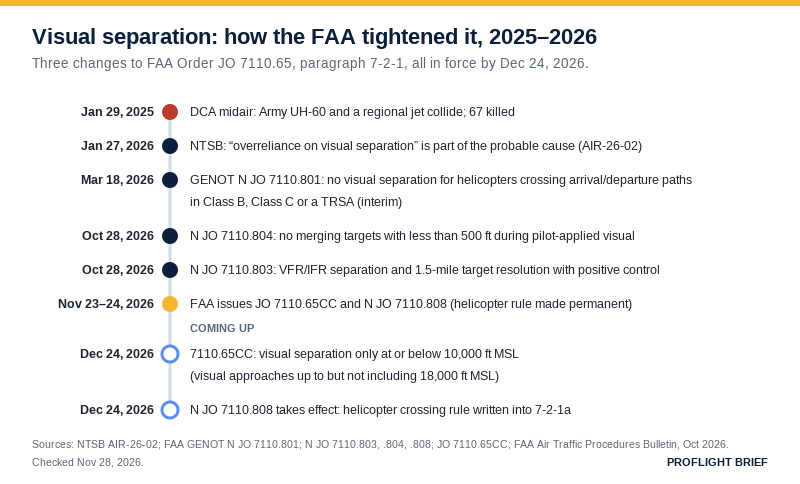
What changes on Dec 24, 2026
Paragraph 7-2-1 of FAA Order JO 7110.65, the controllers’ handbook, is where visual separation lives. Three changes land in it, one already in force since Oct 28 (FAA Order JO 7110.65CC, Air Traffic Control (effective Dec 24, 2026; PDF, 985 pages); FAA Notice N JO 7110.808, Helicopter Separation Procedures (issued Nov 24, 2026; effective Dec 24, 2026); FAA Air Traffic Procedures Bulletin, October 2026 (ATPB 2026-1)):
| 7-2-1 item | Before (JO 7110.65BB) | From Dec 24, 2026 (JO 7110.65CC + N JO 7110.808) |
|---|---|---|
| Altitude, terminal (7-2-1a) | “up to but not including FL180” | “at or below 10,000 feet MSL or between aircraft conducting a visual approach up to but not including 18,000 feet MSL” |
| Altitude, en route (7-2-1b) | “up to but not including FL 180” | Same new wording as terminal: at or below 10,000 ft MSL, or a visual approach up to but not including 18,000 ft MSL |
| Helicopters and powered-lift (7-2-1a) | No exception until the Mar 18, 2026 interim GENOT | “Except for helicopter or powered-lift aircraft crossing the flight path of arriving or departing aircraft within Class B, Class C, or TRSA airspace, visual separation may be applied …” |
| Opening paragraph | “when other approved separation is assured before and after” | “when approved separation exists before and after the application of visual separation. Targets must not be allowed to merge with less than 500 feet vertical separation during pilot-applied visual separation.” (in force since Oct 28 via FAA Notice N JO 7110.804, Visual Separation (effective Oct 28, 2026)) |
The FAA’s reasons, from the 7110.65CC briefing guide: the 10,000 ft limit “allows visual separation to occur at lower airspeeds (see 14 CFR section 91.117) and aligns with current International Civil Aviation Organization (ICAO) guidelines.” Below 10,000 ft MSL the speed limit is 250 knots indicated unless the FAA authorizes otherwise (14 CFR 91.117). For helicopters, Notice 7110.808 says the interim rule was issued “due to an identified medium risk hazard with an upward trend towards a high risk between helicopter or powered-lift aircraft when transiting across the flight path of arriving and departing aircraft,” and that it “has proven to be an effective mitigation to the identified risk, and as a result, the interim procedures will now be permanent” (FAA Notice N JO 7110.808, Helicopter Separation Procedures (issued Nov 24, 2026; effective Dec 24, 2026)).
Dates: the GENOT took effect Mar 18, 2026 at 1600Z and was written to cancel on Dec 24, 2026 (FAA GENOT N JO 7110.801, Interim Helicopter Separation Procedures (effective Mar 18, 2026)). Notice 7110.808 was issued Nov 24, 2026 (FAA directives page for N JO 7110.808) and takes effect Dec 24 with the new edition, JO 7110.65CC, which the FAA issued Nov 23 (FAA directives page for N JO 7110.808; FAA record of change for JO 7110.65CC).
Already in force since Oct 28, 2026
- The 500 ft merge rule (N JO 7110.804). During pilot-applied visual separation, “if the controller becomes aware that the targets will merge with less than 500 feet vertical separation, they must issue control instructions to establish approved separation.” The FAA’s example phraseology: “Targets appear likely to merge, maintain at or below (altitude)” and “TARGETS APPEAR LIKELY TO MERGE, TURN LEFT/RIGHT HEADING (degrees).” The notice says this doesn’t apply to tower-applied visual separation, because “merging target procedures are a function of a radar controller” (FAA Notice N JO 7110.804, Visual Separation (effective Oct 28, 2026)). Its stated basis: a near midair collision “occurs when two aircraft come within less than 500 feet of each other.”
- VFR/IFR separation and target resolution (N JO 7110.803). The FAA notes that “there are no defined standards for VFR to IFR aircraft separation outside of Terminal Radar Service Area (TRSA), Class C, or Class B airspace.” The notice adds a separation paragraph to Section 6, Basic Radar Service to VFR Aircraft: “Separate VFR aircraft from IFR aircraft by any one of the following”: visual separation, 500 ft vertical separation, or target resolution. Target resolution now carries a positive-control rule in the basic radar, TRSA, Class C and Class B sections: “Except when established in a local VFR airport traffic pattern, if the lateral distance between two identified targets will reduce below 1 ½ miles laterally, each aircraft involved must be on an assigned course or heading that ensures target resolution.” Aircraft in a local VFR pattern “are considered to be under positive control” (FAA Notice N JO 7110.803, Separation (effective Oct 28, 2026)). 7110.65CC carries both notices forward.
What it means on frequency
Airplane pilots. “Maintain visual separation” and “follow the traffic” instructions above 10,000 ft MSL should now come only when you’re on a visual approach. In a climb or level above 10,000 ft, expect the controller to use radar or vertical separation instead. If you’ve accepted visual separation and the targets are converging with less than 500 ft between you, expect an altitude restriction or a heading. When you accept visual separation, the AIM says you “must maintain constant visual surveillance and not pass the other aircraft until it is no longer a factor,” and should “promptly notify the controller if visual contact with the other aircraft is lost or cannot be maintained” (AIM 4-4-14, Visual Separation). See and avoid still applies: “When weather conditions permit, regardless of whether an operation is conducted under instrument flight rules or visual flight rules, vigilance shall be maintained by each person operating an aircraft so as to see and avoid other aircraft” (14 CFR 91.113).
Helicopter and powered-lift pilots. Inside Class B, Class C or a TRSA, a controller can’t use visual separation (tower-applied or pilot-applied) to get you across the path of arriving or departing traffic. In Class B airspace, the other options in 7110.65CC 7-9-4 are 1 ½ miles or 500 ft vertical from aircraft over 19,000 lb and turbojets, and target resolution or 500 ft vertical from aircraft of 19,000 lb or less (FAA Order JO 7110.65CC, Air Traffic Control (effective Dec 24, 2026; PDF, 985 pages)). Our read: plan on being held, given an altitude, or routed behind arrivals instead of hearing “traffic in sight, cleared across.” Unchanged: “VFR helicopters and powered-lift aircraft need not be separated from VFR or IFR helicopters or powered-lift aircraft. Traffic advisories and safety alerts must be issued as appropriate” (7110.65CC 7-9-6). The rule covers powered-lift too, which matters for eVTOL flights near big airports (see our eVTOL pilot guide).
Class D towers. The helicopter exception names Class B, Class C and TRSAs only. Since May 19, 2026 (now in 7110.65CC 2-1-21), Class D towers with parallel runways 1,000 ft apart or less must give traffic advisories when one aircraft is straight-in while another turns base to the parallel runway, or when aircraft turn opposing bases (FAA Notice N JO 7110.802, Traffic Advisories (effective May 19, 2026)). From Dec 24, Notice JO 7110.809 also deletes the old 2-1-21 wording that said no separation minima apply to VFR aircraft outside Class B/C airspace or a TRSA, because Section 6 now has separation standards (FAA Notice N JO 7110.809, Traffic Advisories (effective Dec 24, 2026)).
Where this applies in Texas
In the FAA’s Nov 26, 2026 NASR class airspace file, 38 airport records list Class B airspace and 124 list Class C nationwide (FAA NASR 28-day data, class airspace file (cycle effective Nov 26, 2026)). In Texas:
| Airspace | Airports (NASR, Nov 26, 2026) |
|---|---|
| Class B (4) | Dallas-Fort Worth (DFW), Dallas Love (DAL), Houston Bush (IAH), Houston Hobby (HOU) |
| Class C (11) | Abilene (ABI), Dyess AFB (DYS), Amarillo (AMA, Class C 0600–0000, other times E), Austin (AUS), Corpus Christi (CRP), Del Rio (DLF, part-time), El Paso (ELP), Harlingen (HRL, 0600–0000), Lubbock (LBB), Midland (MAF, 0600–0000 per tower/NOTAM), San Antonio (SAT) |
TRSAs aren’t in that file, so we don’t list them here. If you fly the FAA’s Dallas-Ft Worth or Houston helicopter route charts near these airports, see our DCA helicopter rules and route charts guide for the current chart editions and the Texas helicopter pilot jobs guide for who flies there.
Why the FAA did it: the DCA collision
On Jan 29, 2025, a US Army UH-60L and PSA Airlines flight 5342, a CRJ700, collided about 0.5 miles southeast of Reagan National; all 64 people on the airplane and all 3 crewmembers on the helicopter died (NTSB report AIR-26-02 (DCA midair, adopted Jan 27, 2026)). The NTSB’s probable cause includes “the air traffic system’s overreliance on visual separation in order to promote efficient traffic flow without consideration for the limitations of the see-and-avoid concept,” and “the lack of effective pilot-applied visual separation by the helicopter crew.” Its findings say relying on pilot-applied visual separation “as a primary means of separating mixed traffic introduced unacceptable risk” to DCA’s Class B airspace (finding 46). Recommendation A-26-17 asks the FAA for new scenario-based controller training on visual separation, “both tower- and pilot-applied,” including “the inherent limitations of see and avoid.”
The FAA’s October bulletin to controllers makes the same point: “See-and-avoid should not be exclusively relied upon by an air traffic controller in any scenario involving aircraft on an ATC clearance,” quoting NTSB Safety Alert SA-058 on the “inherent limitations” of see-and-avoid (FAA Air Traffic Procedures Bulletin, October 2026 (ATPB 2026-1)). More on the DCA rules in our DCA helicopter guide.
Sources
Checked Nov 28, 2026: FAA Notice N JO 7110.808, Helicopter Separation Procedures (issued Nov 24, 2026; effective Dec 24, 2026); FAA directives page for N JO 7110.808; FAA GENOT N JO 7110.801, Interim Helicopter Separation Procedures (effective Mar 18, 2026); FAA Notice N JO 7110.804, Visual Separation (effective Oct 28, 2026); FAA Notice N JO 7110.803, Separation (effective Oct 28, 2026); FAA Notice N JO 7110.809, Traffic Advisories (effective Dec 24, 2026); FAA Notice N JO 7110.802, Traffic Advisories (effective May 19, 2026); FAA Order JO 7110.65CC, Air Traffic Control (effective Dec 24, 2026; PDF, 985 pages) (Explanation of Changes items a, h, i, k; briefing guide for 7-2-1; paragraphs 7-2-1, 7-6-3, 7-6-4, 7-8-3, 7-9-4, 7-9-6); FAA record of change for JO 7110.65CC; FAA notices list for JO 7110.65BB; FAA Air Traffic Procedures Bulletin, October 2026 (ATPB 2026-1); FAA Order JO 7110.65 (current HTML), 7-2-1 Visual Separation (old 7-2-1 text); AIM 4-4-14, Visual Separation; 14 CFR 91.113; 14 CFR 91.117; NTSB report AIR-26-02 (DCA midair, adopted Jan 27, 2026) (abstract, probable cause, findings 45–46, A-26-17); FAA NASR 28-day data, class airspace file (cycle effective Nov 26, 2026).
What we couldn’t verify
How many facilities or helicopter routes are affected, and any FAA estimate of delays or reroutes: Not published. Which TRSAs exist in Texas: not in the NASR class airspace file, so not listed. Whether the AIM will be revised to mention the 10,000 ft limit: the current AIM 4-4-14 doesn’t, and we found no AIM change saying it will. The ICAO PANS-ATM text the FAA cites wasn’t checked (it isn’t freely published). Cancellation dates: the N JO 7110.808 and 7110.809 PDFs say June 10, 2027; the FAA record-of-change page lists Nov 24, 2028. In the 7110.65CC body, the separation and helicopter paragraphs in Section 6 are numbered 7-6-3 and 7-6-4, and the section title still ends in “Terminal,” while the Explanation of Changes calls them 7-6-2 and 7-6-3 and says “Terminal” was removed; we used the body text. How individual facilities will apply the rules day to day: Not published.
Looking for employers? Browse the pilot employer & flight school directory.
FAQ
What is visual separation?
A way controllers keep aircraft apart without radar or vertical minima: either the tower sees both aircraft and keeps them apart, or a pilot reports the other aircraft in sight and is told to “maintain visual separation” (FAA Order JO 7110.65 7-2-1; AIM 4-4-14). Accepting it means you’ll maneuver as needed to avoid the other aircraft.
What is the new altitude limit for visual separation?
From Dec 24, 2026, JO 7110.65CC allows visual separation between aircraft at or below 10,000 ft MSL, or between aircraft conducting a visual approach up to but not including 18,000 ft MSL. Before, it was allowed up to but not including FL180. The FAA says the change means visual separation happens at lower speeds and matches ICAO guidance.
Can helicopters still get visual separation in Class B airspace?
Not when crossing the flight path of arriving or departing aircraft in Class B, Class C or a TRSA. That interim rule has applied since Mar 18, 2026 (GENOT N JO 7110.801) and becomes permanent Dec 24, 2026 under Notice JO 7110.808. The rule that helicopters need not be separated from other helicopters is unchanged.
What does “targets appear likely to merge” mean now?
Since Oct 28, 2026 (Notice JO 7110.804), if you’re maintaining visual separation and the controller sees the targets will merge with less than 500 ft vertical separation, they must give you a control instruction, e.g. “maintain at or below (altitude)” or a turn to a heading. It applies to radar controllers, not tower-applied visual separation.
Do the visual separation changes apply to VFR pilots?
Yes, in part. Since Oct 28, 2026, controllers giving basic radar service must separate VFR from IFR aircraft by visual separation, 500 ft vertically, or target resolution, and if two targets will come within 1 ½ miles, each aircraft must be on an assigned course or heading (except in a local VFR traffic pattern) (Notice JO 7110.803, carried into JO 7110.65CC).
Why did the FAA tighten visual separation?
After the Jan 29, 2025 DCA midair (67 killed), the NTSB found the air traffic system’s “overreliance on visual separation” was part of the probable cause. The FAA’s October 2026 controller bulletin says see-and-avoid “should not be exclusively relied upon” for aircraft on an ATC clearance.
Related guides
- DCA helicopter rules & route charts
- Line up and wait (LUAW) rules
- Runway incursions & crossing callout
- ADS-B In mandate
- Helicopter aerial photography rules
- Pilot in command authority (14 CFR 91.3)
- eVTOL / powered-lift pilot
- Helicopter pilot jobs in Texas
- FAA ground stops explained
- Wet runway landing distance & overruns
- Free 2026 Pilot Pay Guide (PDF)
Data checked Nov 2026. Pay and postings change, so verify with the employer. Estimates are labeled.