Guides · Updated
Wet Runway Landing Distance and Overruns: The FAA 115% Rule, TALPA Landing Distance Factors and the Two 2026 Miami Cargo Overruns
Updated Nov 27, 2026. This page explains the FAA rules and guidance on landing distance when the runway is wet, and what’s known so far about two cargo overruns at Miami this fall. Every rule links to the eCFR, every number to an FAA advisory circular, FAA data or the NTSB. Nothing here is a cause: the NTSB has not determined the cause of either Miami event. It isn’t training or legal advice; your AFM, your operator’s performance data and your SOPs govern.
Why this is in the news: FedEx 910 at Miami, Nov 25, 2026
- What happened: “A FedEx aircraft overran Runway 26R at Miami International Airport at approximately 8:40 p.m.” (7:40 p.m. CT) on Wednesday, Nov 25, and “there are no reported injuries” (Miami International Airport on X (Nov 25, 2026, first statement)). The FAA said FedEx Flight 910, a McDonnell Douglas MD-11 from Memphis, “ran off the runway after landing” and that “the FAA will investigate the incident” (FAA on X (Nov 25, 2026)).
- NTSB: on Thursday, Nov 26, the NTSB posted that it “is investigating the Nov. 25 FedEx MD-11 runway excursion at Miami International Airport” (NTSB Newsroom on X (Nov 26, 2026)). No preliminary report as of Nov 27.
- Airport impact: right after the event, all runways except 9R closed. By 12:17 a.m. EST, 9-27 was open for arrivals and departures and 12/30 for departures only (reopened 10:30 p.m.) (MIA update (Nov 26, 2026, 12:17 a.m. EST)). Thursday morning three of four runways were open and 8L-26R stayed closed (MIA update (Nov 26, 2026, 7:59 a.m. EST)).
- The runway: FAA airport data lists 8L/26R as 8,600 ft × 150 ft, grooved asphalt, with 8,600 ft of landing distance available on 26R, no displaced threshold, a localizer with DME (listed as LOC/DME) and a 4-light PAPI. The FAA arresting-system list for MIA shows no EMAS on any runway (FAA NASR 28-day airport data (cycle effective Nov 26, 2026)).
- The weather (raw reports from KMIA METAR/SPECI reports (aviationweather.gov)):
- 7:53 p.m. EST (0053Z):
19006G18KT 7SM -RA FEW020 BKN040 BKN090 OVC130 23/22 A2979 - 8:38 p.m. EST (0138Z, special report, 2 minutes before the overrun):
18007KT 8SM -TSRA FEW015 BKN030CB BKN070 OVC130 23/22 A2979 RMK AO2 TSB34 OCNL LTGICCG NE-E TS NE-E MOV NE P0028. A thunderstorm began at 0134Z (8:34 p.m. EST), and 0.28 inch of rain had fallen since 7:53 p.m. - 8:53 p.m. EST (0153Z):
20006KT 8SM -RA … TSB34E49 … P0028, so the thunderstorm ended at 8:49 p.m. and 0.28 inch fell in that hour.
- 7:53 p.m. EST (0053Z):
- Not published yet: touchdown point, speed, runway condition at the time, braking action reports, whether reversers and spoilers deployed, the aircraft’s weight, the crew’s landing distance assessment, and where the airplane stopped in feet. We will update this page when the NTSB preliminary report is out.
The earlier Miami overrun: 21 Air 7598, Sep 6, 2026
From the NTSB preliminary report (NTSB preliminary report DCA26MA352 (21 Air flight 7598); NTSB investigation page DCA26MA352, updated Oct 1, 2026, status “Ongoing”). It is “preliminary and subject to change” and gives no cause. This was a different runway and a daytime landing with thunderstorms reported at the airport; we include it because it shows how the overrun factors below stack up.
- Flight: a Boeing 767-33A freighter flying for Amazon under Part 121 from San Juan overran runway 30 at about 1:53 p.m. EDT (12:53 p.m. CT), hit a passenger van on the perimeter road and an SUV on NW 67th Avenue, and came to rest about 1,200 ft beyond the pavement. Five people on the ground were killed and three seriously injured; the two pilots had minor injuries.
- Approach and touchdown: about 105 ft above ground at 177 knots groundspeed over the runway 30 threshold; main gear tire marks about 3,750 ft and 3,820 ft past the threshold at about 160 knots, about 13 seconds after crossing it.
- Deceleration: the speed brakes stayed stowed and the thrust reversers did not deploy. Wheel brakes went on at 146 knots, were released about 8 seconds later at 120 knots as the thrust went to go-around values with about 930 ft left, then went back on at 117 knots with about 415 ft left. The airplane left the runway at 113 knots.
- Cockpit voice recorder: the first officer “cautioned they were too fast” and kept commenting on the speed; there “was not a consistent verbal response.” “Sink rate,” “too low terrain” and “minimums” alerts sounded; the captain called for a go-around about 16 seconds after the touchdown sounds.
- Wind and ATC: the ASOS reported 190° at 17 knots gusting 26 at 1:53 p.m. The local controller cleared the flight to land “but did not issue information about the wind”; the NTSB notes JO 7110.65BB requires wind direction and speed when a tailwind component exists. Our calculation with runway 30’s true alignment of 299°: about 5.5 knots of tailwind (8.5 in the gusts) and 16 knots of crosswind.
- Runway: 12/30 is 9,360 ft × 150 ft including a displaced threshold for runway 30; no EMAS at the end of runway 30. FAA data lists 7,913 ft of landing distance available on 30 (FAA NASR 28-day airport data (cycle effective Nov 26, 2026)).
- Crew: captain about 7,267 hours, 150 in the 767 (type rating May 18, 2026); first officer about 2,800 hours, 800 in the 767; first time flying together that day.
The rules: 60% dry, 115% of that when wet
These are dispatch (preflight) rules for turbine airplanes under Parts 121 and 135 (large transport category) and Part 91 subpart K fractional programs. The AFM landing distance from 50 ft over the threshold must fit within 60% of the effective runway length (14 CFR 121.195 (b); 14 CFR 135.385 (b); 14 CFR 91.1037 (b)). In practice, AFM distance × 1.667 ≤ runway length (AC 91-79B 2.1.2.1).
- Wet or slippery: if “the appropriate weather reports and forecasts … indicate that the runways at the destination airport may be wet or slippery at the estimated time of arrival,” a turbojet may not take off unless the effective runway length is “at least 115 percent” of the dry requirement, unless the AFM has an approved shorter wet-runway distance (14 CFR 121.195(d); 135.385(d); 91.1037(e)). Worked example from the FAA: a 3,000 ft AFM distance needs 5,000 ft dry and 5,750 ft wet (AC 91-79B 2.1.2.2).
- Turboprops: 70% of the runway at an alternate if they can’t meet the destination rule (121.195(c); 135.385(c)).
- Eligible on-demand / Destination Airport Analysis: 80% (AFM × 1.25) when authorized (135.385(f); 91.1037(c)). The FAA warns that “in most cases” this “will not provide a safe landing margin if the runway is either wet or contaminated.”
- Part 91 (not 91K): no numeric rule; preflight planning falls under 91.103 and 91.605, and the FAA “recommend[s]” planning from the AFM anyway (AC 91-79B 2.1.4).
Two FAA cautions worth memorizing (AC 91-79B 2.1.2.2): the 15% “is not based on demonstrated wet runway stopping performance; therefore, wet runway factored landing distance may not provide enough runway for the aircraft to stop.” And “there exists a common misconception that grooved runways or runways covered in PFC are considered dry.” They are not: the 15% still applies. The FAA also explains why AFM numbers are optimistic: certification landings can use sink rates “as high as 480 ft per minute,” −3.5° approach angles and maximum manual braking “initiated as soon as possible” (AC 91-79B 2.2.1), and the § 25.125 distance is measured on “a level, smooth, dry, hard-surfaced runway” (14 CFR 25.125).
TALPA: the time-of-arrival landing distance check
Dispatch math is done hours earlier, often for a different runway and different weather. After a Southwest 737 overran at Chicago Midway on Dec 8, 2005, the FAA issued SAFO 06012 (Aug 31, 2006) urging time-of-arrival assessments and set up the Takeoff and Landing Performance Assessment (TALPA) committee (FAA AC 25-32, Landing Performance Data for Time-of-Arrival Landing Performance Assessments (Dec 22, 2015), section 4). The FAA adopted several of the committee’s recommendations, including standardized runway condition reporting, and implemented them on Oct 1, 2016 (AC 91-79B 1.5.1–1.5.2). There is still no rule requiring the arrival check: “current regulations do not require a landing distance assessment be performed at the TOA,” but the FAA “strongly recommend[s]” one (AC 91-79B 3.2, 2.2.3).
- When: usually before top of descent, including “how much deterioration in field conditions can be tolerated” so a late worse report can be handled fast (3.3.1).
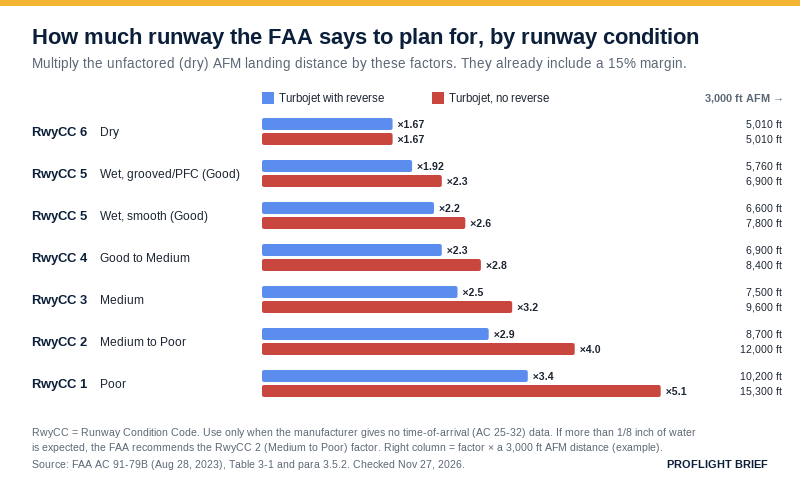
- Which data: the manufacturer’s or a provider’s advisory data built to AC 25-32 if you have it. If not, multiply the unfactored, dry AFM distance by the landing distance factor (LDF) in the chart above (3.3.2). The LDFs include the 15% margin, a normal air distance, temperature, approach speed and braking effects.
- Margin: add “at least 15 percent” to the operational landing distance, and “except under emergency conditions, flightcrews should not attempt to land on runways that do not meet” it (3.1).
- Which report: use “the most adverse reliable braking action report” or the most adverse expected conditions, and check its age: “several overruns have occurred when pilots were provided with a runway condition that was no longer reliable given changes in meteorological conditions” (3.3, 3.4.1).
Runway condition codes (RwyCC)
A number from 0 to 6 for each third of the runway (touchdown, midpoint, rollout), “with 0 being extremely slippery and 6 being a dry runway” (FAA AC 25-32, Landing Performance Data for Time-of-Arrival Landing Performance Assessments (Dec 22, 2015), 6.6; AIM 4-3-8 and 4-3-9 (braking action and runway condition reports)). From AC 25-32 Table 2:
- 6: dry.
- 5 (Good): wet (includes damp and 1/8 inch or less of water), frost, or 1/8 inch or less of slush, dry snow or wet snow.
- 4 (Good to Medium): compacted snow at −15 °C or colder.
- 3 (Medium): wet “slippery when wet” runway; snow over compacted snow; more than 1/8 inch of dry or wet snow; compacted snow warmer than −15 °C.
- 2 (Medium to Poor): more than 1/8 inch of water or slush.
- 1 (Poor): ice. 0 (Nil): wet ice, water on compacted snow, snow over ice; no operations.
Definitions: “wet” means more than 25% of the surface has visible dampness or water 1/8 inch (3 mm) or less, and a damp runway counts as wet “regardless of whether or not the surface appears reflective.” More than 1/8 inch of water is “contaminated” (AC 25-32 6.2, 6.3, 6.3.6). Controllers don’t issue codes when all three thirds are 6 (AIM 4-3-9).
Example with real numbers
Take the FAA’s 3,000 ft AFM distance for a turbojet with reverse. Dispatch wet needs about 5,750 ft. At arrival, a wet grooved runway (RwyCC 5) needs 3,000 × 1.92 = 5,760 ft; a wet smooth one 6,600 ft; standing water (RwyCC 2) 8,700 ft. Turned around (our arithmetic, not airplane data): an 8,600 ft runway like MIA 26R covers an unfactored AFM distance of up to about 4,480 ft at the wet-grooved factor, but only about 2,970 ft at the RwyCC 2 factor. The MD-11’s AFM landing distance for that night isn’t public, so we can’t say which side of that line Flight 910 was on.
Heavy rain and standing water
- Wet can be worse than “wet”: overrun data showed braking “significantly lower than expected for a wet runway,” on “both grooved and ungrooved runways,” and the FAA says the 15% margin on wet data “may be inadequate in certain wet runway conditions” (AC 91-79B 3.5).
- Thunderstorms: “in a rainfall event, such as an active thunderstorm, the amount of water … on a runway can change rapidly.” If you expect more than 1/8 inch of water, use the RwyCC 2 (Medium to Poor) factor; on a smooth runway in moderate or heavy rain, or a grooved/PFC runway in heavy rain, consider that the water may be deeper than 1/8 inch (3.5.1–3.5.2).
- The report won’t keep up: “A Special Weather Observation (SPECI) will only be generated if a thunderstorm begins. A SPECI is not generated when rainfall rates simply change,” ATC radar “is not optimized for the detection of rainfall,” and PIREPs “can rapidly become obsolete” (3.5.2 note).
- Standing water: braking can degrade “in a matter of seconds, resulting in up to a 77-percent decrease in braking force,” the airplane can feel like it accelerates, and the surprise can delay reversers or spoilers. “Only 1/8 inch of water separates a wet runway (with a RwyCC of 5 and ‘good’ braking action) from a runway contaminated with standing water (and a RwyCC of 2 and ‘medium to poor’ braking action)” (3.6, 3.6.1).
- Hydroplaning speed: AC 25-32 estimates the dynamic hydroplaning speed as 9 × √(tire pressure in psi) in knots of groundspeed (Table 2, note 4). The now-canceled AC 91-79A used 8.6 × √psi; same idea, slightly lower number.
- Crosswind: with standing water, “tire cornering limitations can reduce wheel braking capability,” and crosswind limits “can become a dominant factor” in the arrival assessment. Most airplanes publish only a demonstrated crosswind, not a limit (3.10).
Overrun rules of thumb (AC 91-79B chapter 5)
- Speed: 10% fast on final ≈ 20% more landing distance. Example: Vref 120 knots and 3,000 ft; 132 knots over the threshold needs 3,600 ft.
- Height: every 10 ft above the standard 50 ft threshold height adds 200 ft; crossing at 100 ft adds about 1,000 ft.
- Tailwind: the first 10 knots add 21% (3,000 ft becomes 3,630 ft). Certification already requires the AFM to count at least 150% of a reported tailwind and no more than 50% of a headwind (14 CFR 25.125 (f)). A slipperier-than-expected runway is “amplified in tailwind conditions” (3.7 note).
- Weight: 10% heavier ≈ 5% faster and 10% longer.
- Slope: 1% downhill ≈ 10% longer.
- Touchdown point: operational data usually allows 1,500 ft or 7 seconds from threshold to touchdown; 1,000 ft only with extra training and procedures (3.9). The ATP test standard’s touchdown zone is 500–3,000 ft and never past the first third (AC 91-79A, App. 1).
- Deceleration devices: “A 2-second delay at speeds of 200 ft/second (118 kts) increases the airplane stopping distance by almost 400 ft”; add 200 ft for each second beyond 2 seconds. Arm the auto spoilers and verify they deploy.
- They add up: “The LDA can be exceeded when a cumulative effect of the above conditions exists” (5.2.10).
EMAS: the safety net most runways don’t have
An engineered materials arresting system (crushable blocks past the runway end) stops an overrunning airplane. In the FAA’s Nov 26, 2026 NASR airport data, 120 runway ends at 70 airports list EMAS (FAA NASR 28-day airport data (cycle effective Nov 26, 2026)). MIA lists none; the NTSB confirmed none at the end of runway 30. In Texas, NASR lists EMAS at only three runway ends: Addison (ADS) runway 16, Laredo (LRD) 18R and McAllen (MFE) 32. If you fly into DFW-area airports, know which ones have it and which don’t.
What it means for pilots
- Brief the wet runway before descent: RwyCC, report time, the factor you’ll use, and the worst report you’ll accept. If a thunderstorm is over the field, plan for RwyCC 2 and decide on a hold or alternate before you’re on final.
- Treat grooved as wet, not dry.
- Fly the numbers: stabilized (the canceled AC 91-79A used 1,000 ft in IMC and 500 ft in VMC; use your SOP gates), Vref plus wind and gust additives to 50 ft over the threshold, touchdown at the planned point. If not, go around: AC 91-79B and SAFO 10005 make the go-around and the reasons for it part of training.
- Ask for the wind if the tower doesn’t give it, and do the tailwind math yourself.
- Get on the brakes, reversers and spoilers right away: arm auto spoilers before landing and verify they deployed (AC 91-79B 5.2.8.2).
- Report braking action with the standard terms (good, good to medium, medium, medium to poor, poor, nil) and which part of the runway (AIM 4-3-8).
- Turboprops and pistons: turboprops use the turboprop row (1.67 dry to 2.9 poor) only if the AFM gives landing distance credit for ground idle; otherwise use the no-reverse turbojet row. Pistons: the reciprocating row matches the no-reverse turbojet row (1.67 dry to 5.1 poor). More on cargo flying in our cargo pilot jobs guide, and on the runway environment in runway incursions and line up and wait.
Sources
Checked Nov 27, 2026: FAA AC 91-79B, Aircraft Landing Performance and Runway Excursion Mitigation (Aug 28, 2023) (sections 1.4–1.5, 2.1–2.2, 3.1–3.13, 4.8, 5.2, Table 2-1, Table 3-1); FAA advisory circular page for AC 91-79B; FAA AC 25-32, Landing Performance Data for Time-of-Arrival Landing Performance Assessments (Dec 22, 2015) (sections 4–6, 8.2, Table 2); 14 CFR 121.195; 14 CFR 135.385; 14 CFR 91.1037; 14 CFR 25.125 (eCFR, current); AIM 4-3-8 and 4-3-9 (braking action and runway condition reports); NTSB Newsroom on X (Nov 26, 2026); FAA on X (Nov 25, 2026); Miami International Airport on X (Nov 25, 2026, first statement); MIA update (Nov 26, 2026, 12:17 a.m. EST); MIA update (Nov 26, 2026, 7:59 a.m. EST); KMIA METAR/SPECI reports (aviationweather.gov) (raw reports retrieved Nov 27, 8:30 a.m. CT); FAA NASR 28-day airport data (cycle effective Nov 26, 2026) (APT_RWY, APT_RWY_END and APT_ARS files); NTSB preliminary report DCA26MA352 (21 Air flight 7598); NTSB investigation page DCA26MA352. AC 91-79A Change 2 (Feb 20, 2018; canceled by AC 91-79B) was used only for the touchdown-zone and 8.6 √psi notes.
What we couldn’t verify
FedEx 910: touchdown point and speed, runway condition code or braking reports at the time, reverser/spoiler use, landing weight, the crew’s landing distance assessment, how far past the runway end the airplane stopped, the aircraft registration and the NTSB case number: Not published as of Nov 27. FedEx’s own statement was quoted only in the press, so it isn’t used. Press reports of “crosswinds” and video of the airplane near the fence weren’t used; we used the airport, FAA and NTSB posts and the raw METARs. The winds we computed are surface sensor readings at their report times, not the wind at touchdown. AC 91-79B cites 121.195(e) for the wet rule in its text, but the eCFR puts it in 121.195(d) (and 91.1037(e)); we follow the eCFR. The EMAS counts come from the FAA NASR arresting-system file; we didn’t cross-check them against FAA airport diagrams. 21 Air 7598: all facts are from the preliminary report and may change; no probable cause yet.
Looking for employers? Browse the pilot employer & flight school directory.
FAQ
How much more runway do you need when it’s wet?
For dispatch, airline, Part 135 and fractional turbojets need the runway to be at least 115% of the dry requirement, and the dry requirement is the AFM distance ÷ 0.60. So a 3,000 ft AFM distance needs 5,000 ft dry and 5,750 ft wet (14 CFR 121.195(b) and (d); AC 91-79B). At arrival, the FAA’s landing distance factor for a turbojet with reverse on a wet grooved runway is 1.92 × the AFM distance, 2.2 on a wet smooth runway.
Is a grooved runway considered dry?
No. The FAA calls that “a common misconception”: the 15% wet increase still applies on grooved or PFC runways if the runway will be wet on landing (AC 91-79B 2.1.2.2). Grooving helps drainage but in time-of-arrival terms a wet grooved runway is still RwyCC 5, with a higher factor than dry.
What runway condition code is a wet runway?
RwyCC 5 (braking “good”) if the water is 1/8 inch (3 mm) or less, including damp. A “slippery when wet” runway is RwyCC 3, and more than 1/8 inch of water is RwyCC 2 (“medium to poor”) (AC 25-32 Table 2). In heavy rain the FAA recommends using the RwyCC 2 factor if you expect more than 1/8 inch.
Is a time-of-arrival landing distance assessment required?
Not by regulation. AC 91-79B says “current regulations do not require a landing distance assessment be performed at the TOA” but strongly recommends one, with at least a 15% margin, and says crews should not land on runways that don’t meet it except in an emergency. Many operators require it in their SOPs and OpSpecs.
What caused the FedEx MD-11 overrun at Miami?
Not determined. The NTSB said on Nov 26, 2026 that it is investigating the Nov 25 runway excursion on runway 26R; no preliminary report is out yet. Airport weather reports show a thunderstorm and rain at the field at the time, with the wind nearly straight across the runway, but the NTSB hasn’t said what role, if any, weather played.
What happened in the Amazon cargo plane overrun at Miami?
On Sep 6, 2026, 21 Air flight 7598, a 767 freighter flying for Amazon, crossed the runway 30 threshold about 105 ft high at 177 knots groundspeed, touched down about 3,750 ft down the runway at 160 knots, didn’t deploy speed brakes or reversers, and overran onto a road; five people on the ground died. That’s from the NTSB preliminary report; there is no probable cause yet.
What speed do tires hydroplane at?
AC 25-32 estimates the dynamic hydroplaning speed as 9 × the square root of tire pressure in psi, in knots of groundspeed (older AC 91-79A used 8.6). Once it starts, hydroplaning can continue to a lower speed, and the FAA says braking force can drop up to 77% in seconds in standing water.
Related guides
- Runway incursions & crossing callout
- Line up and wait (LUAW) rules
- Cargo pilot jobs compared
- Airliner ADs this month
- FAA ground stops explained
- Pilot in command authority (14 CFR 91.3)
- Pilot duty time & rest rules
- How to become a flight instructor (CFI)
- Airline pilot hiring 2026
- Free 2026 Pilot Pay Guide (PDF)
Data checked Nov 2026. Pay and postings change, so verify with the employer. Estimates are labeled.