Guides · Updated
FAA Ground Stops Explained (2026): What Happened on Nov 13, What Pilots Do, and the Duty, Tarmac and Refund Rules
What happened on Nov 13, 2026
All figures below are from the FAA’s own Q&A, published Nov 15, 2026 (FAA: Nationwide Ground Stop Questions and Answers (Nov 15, 2026)):
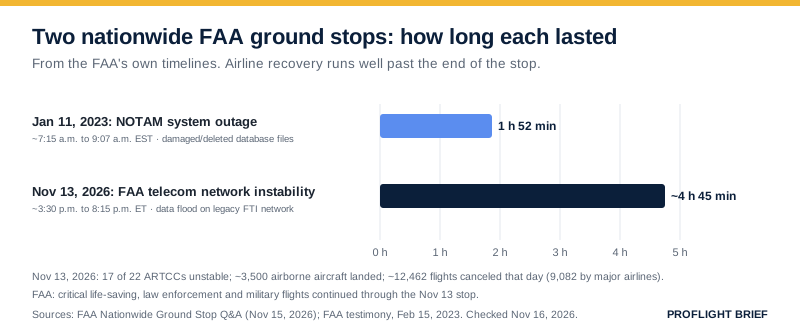
- When: nationwide ground stop issued at about 3:30 p.m. ET on Friday, Nov 13; the system was stable and traffic resumed as of 8:15 p.m. ET the same day (about 2:30 to 7:15 p.m. CT).
- What failed: the FAA’s legacy equipment became unstable when data flooded the FAA’s FTI telecommunications network at about 1,000 connection attempts every 4 to 5 seconds, disrupting aircraft communications and radar feeds. The FAA calls it the “legacy TDM system,” not its modernization program.
- Where: instability at 17 of the FAA’s 22 Air Route Traffic Control Centers, spreading into several TRACONs. The initial investigation points to two sites: a radar site in Amarillo, Texas and a radio site in El Dorado, Arkansas, where network provider L3Harris had been deploying a new router. L3Harris blocked both sites and the network stabilized.
- Not a full outage: some frequencies and radar feeds stayed up, and the FAA says critical life-saving, law enforcement and military flights continued.
- Traffic: about 3,500 airborne aircraft landed safely. Operators canceled about 12,462 flights that day, 9,082 of them by major airlines; the FAA notes not every cancellation was caused by the ground stop.
- Cause and fix: no indication of a cyberattack. The FAA disabled the broadcasting function on the new routers and on about 60 similar routers as a precaution, and says it will reevaluate doing replacement work in daytime. The FAA and L3Harris are still investigating the root cause.
What a ground stop is
The FAA’s definition, word for word in both the Pilot/Controller Glossary and the controllers’ manual: a ground stop is “a process that requires aircraft that meet a specific criteria to remain on the ground. The criteria may be airport specific, airspace specific, or equipment specific,” and ground stops “normally occur with little or no warning” (FAA Pilot/Controller Glossary, G (effective Jul 9, 2026); FAA Order JO 7210.3EE, Chapter 18, Section 13: Ground Stop(s) (effective Jul 9, 2026)).
The rules controllers work under (FAA Order JO 7210.3EE, paragraphs 18-13-1 to 18-13-6, FAA Order JO 7210.3EE, Chapter 18, Section 13: Ground Stop(s) (effective Jul 9, 2026)):
- It overrides everything. A ground stop overrides all other traffic management initiatives, and aircraft “must not be released” without approval of whoever originated it.
- It’s a last resort. Because it is “one of the most restrictive methods of traffic management,” alternatives must be explored first. The manual lists when to use one: severely reduced capacity (weather below most users’ minimums, runway closed for snow removal, accidents), to avoid long airborne holding, to keep a sector or center from saturating or an airport from gridlock, when a facility can’t fully provide ATC services “due to unforeseen circumstances,” and when routes are unavailable because of severe weather or catastrophic events. Nov 13’s telecom failure fits the unforeseen-circumstances case.
- Local vs national. A facility can start a local ground stop only when everything affected is inside its own area and it isn’t expected to last more than 30 minutes; extending it needs Command Center (ATCSCC) approval. A national ground stop is run by the ATCSCC, which must issue an advisory listing the airport, facilities included, expect-update time, reason and probability of extension.
- Helicopters. Helicopters are exempt from weather-based ground stops unless the center specifically includes them when it requests the stop.
Ground stop vs ground delay program vs EDCT
| Term | What it means for you | Source |
|---|---|---|
| Ground stop (GS) | You don’t depart at all until the stop is lifted or you’re individually released. Usually no warning, no assigned time. | FAA Pilot/Controller Glossary, G (effective Jul 9, 2026); FAA Order JO 7210.3EE, Chapter 18, Section 13: Ground Stop(s) (effective Jul 9, 2026) |
| Ground delay program (GDP) | Run by the ATCSCC; flights are held on the ground and given delays to limit airborne holding, assigned “equitably” to all users. | FAA Pilot/Controller Glossary, G (effective Jul 9, 2026); JO 7210.3EE, Chapter 18, Section 10: Ground Delay Programs |
| Expect Departure Clearance Time (EDCT) | Your assigned runway release time in a traffic management program. The AIM expects you to depart no earlier than 5 minutes before and no later than 5 minutes after it. | FAA Pilot/Controller Glossary, E; AIM 5-2-7 |
What pilots should do in a ground stop
- Check the advisories. The ATCSCC issues advisories for ground stops and ground delay programs (AIM 5-1-4 and 5-1-13); the FAA points the public to FAA NAS Status for real-time airport status. Note the expect-update time.
- Keep your IFR flight plan alive. Most centers delete proposed flight plans that haven’t been activated a minimum of 2 hours after the proposed departure time or EDCT. If you’ll be 2 or more hours late, the AIM asks you to give ATC a new proposed time, and recommends sending it through a flight plan service provider or FSS because ATC often can’t take revisions by radio during saturation (AIM 5-1-13, AIM 5-1-4 and 5-1-13).
- If you lose two-way radio in flight, 14 CFR 91.185 applies: in VFR conditions, stay VFR and land as soon as practicable; in IFR, fly the route in your last clearance (or vectors-to-fix, expected route, then filed route) at the highest of your assigned, minimum IFR or expected altitude, and leave the clearance limit per your EFC or ETA (14 CFR 91.185 (eCFR)). On Nov 13 the FAA says it never lost all radio and radar, but the rule is the backstop.
- You are still PIC. Emergency authority under 91.3 doesn’t change in a ground stop. See our pilot in command authority guide.
- Watch your duty clock (next section) and your passengers’ tarmac clock (the one after).
Duty time: what a ground stop does to a Part 117 crew
14 CFR 117.19 (14 CFR 117.19 (eCFR)) lets the PIC and the airline extend a flight duty period when “unforeseen operational circumstances” arise:
- Before takeoff: up to 2 hours beyond the Table B or C maximum. An extension of more than 30 minutes can happen only once before the crew gets a 117.25(b) rest period, and it can’t push the pilot past the cumulative FDP limits in 117.23(c).
- After takeoff: as far as necessary to safely land at the next destination or alternate, and this one may exceed the cumulative limits.
- Reporting: the airline must report to the FAA within 10 days any FDP extended more than 30 minutes past the table maximum.
Look up your own maximum with the Part 117 duty-day tool. Pay protection when trips cancel depends on your contract, not the FAA; see the pilot contract tracker.
The tarmac clock: 3 hours domestic, 4 international
Under 14 CFR 259.4 (14 CFR 259.4 (eCFR)), a covered airline must give passengers the chance to deplane before a tarmac delay passes 3 hours on domestic flights or 4 hours on international flights, provide food and water within 2 hours, keep lavatories working, and update passengers once the delay passes 30 minutes. Exceptions include the PIC deciding deplaning would jeopardize safety or security, and ATC advising that returning to a gate would significantly disrupt airport operations.
What passengers are owed when flights cancel
Under DOT’s refund rule, if your flight is canceled or “significantly delayed or changed” and you decline rebooking or a voucher, the airline (as merchant of record) owes a full refund of the fare, taxes and ancillary fees (14 CFR 260.6, 14 CFR 260.6 (eCFR)). “Significantly delayed” means 3 or more hours for domestic itineraries and 6 or more for international (14 CFR 260.2 (eCFR)).
The Jan 11, 2023 NOTAM ground stop
After the FAA’s NOTAM system failed overnight, Acting Administrator Billy Nolen ordered a ground stop at about 7:15 a.m. EST, “pausing all departures in the United States,” and lifted it at 9:07 a.m. EST after resiliency testing (FAA Acting Administrator Billy Nolen, Senate testimony (Feb 15, 2023)). The FAA’s preliminary review found contract personnel unintentionally deleted files while correcting synchronization between the primary and backup databases, with no evidence of a cyberattack (FAA NOTAM statement (Jan 11 and 19, 2023)). Nov 13, 2026 lasted about two and a half times as long.
Texas angle
One of the two sites the FAA named is a radar site in Amarillo, Texas. The FAA hasn’t said which 17 centers became unstable, so we can’t say how Fort Worth Center or the DFW TRACON were affected. Flying out of DFW? See DFW pilot jobs and the Texas pilot directory.
Sources
Checked Nov 16, 2026: FAA: Nationwide Ground Stop Questions and Answers (Nov 15, 2026); FAA Order JO 7210.3EE, Chapter 18, Section 13: Ground Stop(s) (effective Jul 9, 2026); JO 7210.3EE, Chapter 18, Section 10: Ground Delay Programs; FAA Pilot/Controller Glossary, G (effective Jul 9, 2026); FAA Pilot/Controller Glossary, E; AIM 5-1-4 and 5-1-13; AIM 5-2-7; 14 CFR 91.185 (eCFR); 14 CFR 117.19 (eCFR); 14 CFR 259.4 (eCFR); 14 CFR 260.6 (eCFR); 14 CFR 260.2 (eCFR); FAA Acting Administrator Billy Nolen, Senate testimony (Feb 15, 2023); FAA NOTAM statement (Jan 11 and 19, 2023). eCFR text as of Nov 12, 2026; AIM, Pilot/Controller Glossary and JO 7210.3EE effective Jul 9, 2026.
What we couldn’t verify
The root cause is still under investigation by the FAA and L3Harris; we’ll update when a final report is published. The FAA hasn’t listed which 17 centers were affected, and we didn’t read the ATCSCC advisory text for Nov 13. “Traffic resumed as of 8:15 p.m.” is the FAA’s wording; the exact time the national ground stop advisory was cancelled is not published on the pages we read. The FAA doesn’t publish a list of all past nationwide ground stops, so we don’t claim either event was a “first.” News cancellation counts (e.g. FlightAware or Flightradar24 tallies) aren’t used; the 12,462 figure is the FAA’s. Individual airline pay protection for canceled trips is contract-specific and not covered here.
Looking for employers? Browse the pilot employer & flight school directory.
FAQ
What is an FAA ground stop?
An FAA traffic management order that keeps aircraft meeting set criteria (a destination airport, an airspace, or a type of equipment) on the ground. It overrides all other traffic management initiatives, usually comes with little or no warning, and aircraft are released only with approval of whoever issued it (FAA Order JO 7210.3EE, 18-13).
What caused the Nov 13, 2026 nationwide ground stop?
Per the FAA, data flooded its legacy telecom (FTI) network at about 1,000 connection attempts every 4 to 5 seconds, making radio and radar feeds unstable at 17 of 22 en route centers. The initial investigation points to a radar site in Amarillo, Texas and a radio site in El Dorado, Arkansas, where L3Harris was installing a new router. The FAA found no indication of a cyberattack; the root cause is still under investigation.
How long did the Nov 13 ground stop last?
About 4 hours 45 minutes: issued around 3:30 p.m. ET, with traffic resuming at 8:15 p.m. ET. The Jan 11, 2023 NOTAM ground stop lasted 1 hour 52 minutes (7:15 to 9:07 a.m. EST).
What is the difference between a ground stop and a ground delay program?
A ground stop holds flights with no assigned departure time until it is lifted. A ground delay program assigns each flight a delay and an Expect Departure Clearance Time (EDCT); the AIM expects you to depart within 5 minutes either side of your EDCT.
Can airline pilots exceed duty limits because of a ground stop?
Under 14 CFR 117.19, unforeseen operational circumstances before takeoff allow up to a 2-hour flight duty period extension (more than 30 minutes only once before rest, and not past cumulative limits). After takeoff, the FDP can be extended as needed to land safely. Extensions over 30 minutes must be reported to the FAA within 10 days.
Are passengers owed a refund when a ground stop cancels their flight?
Under DOT’s rule (14 CFR 260.6), a canceled or significantly delayed flight (3+ hours domestic, 6+ international) entitles a passenger who declines rebooking or a voucher to a full refund of fare, taxes and fees.
Do helicopters have to follow ground stops?
Helicopters are exempt from weather-based ground stops unless the center specifically includes them when requesting the stop (JO 7210.3EE, 18-13-2 note). On Nov 13, 2026 the FAA says critical life-saving, law enforcement and military flights continued.
Related guides
- ADS-B In mandate
- Pilot oxygen requirements
- Pilot duty time & rest rules
- Pilot in command authority (14 CFR 91.3)
- FAA pilot jobs (Flight Test & ASI)
- Pilot contract tracker
- Pilot strike watch
- HEMS / air medical pilot jobs
- Airline pilot hiring 2026
- Pilot mental health & the FAA medical
- Free 2026 Pilot Pay Guide (PDF)
Data checked Nov 2026. Pay and postings change, so verify with the employer. Estimates are labeled.