Guides · Updated
Pilot Oxygen Requirements (2026): Part 91, 135 and 121 Rules, and the FAA’s Proposal to Raise Mask Altitudes
Comment deadline: Nov 23, 2026. The FAA’s oxygen-mask proposal (Notice No. 26-17, docket FAA-2026-12145) is open for comment until then; Regulations.gov lists the closing time as 11:59 p.m. ET (10:59 p.m. CT). It had 29 posted comments when we checked on Nov 17, 2026 (Docket FAA-2026-12145 on Regulations.gov). It is a proposal: nothing below in the “proposed” columns is in effect.
Unpressurized aircraft: when you must use oxygen
These are cabin pressure altitudes. In an unpressurized airplane or helicopter that is the altitude you’re flying.
| Rule | Pilots (required crew) | Passengers |
|---|---|---|
| Part 91 (14 CFR 91.211 (eCFR), paragraph (a)) | Above 12,500 ft up to 14,000 ft: use oxygen for any portion over 30 minutes. Above 14,000 ft: use it the entire time. | Above 15,000 ft: oxygen must be provided to each occupant (they don’t have to use it). |
| Part 135 (14 CFR 135.89 (eCFR)(a); equipment in 14 CFR 135.157 (eCFR)(a)) | Above 10,000 ft through 12,000 ft: use oxygen for any portion over 30 minutes. Above 12,000 ft: use it continuously. | Above 10,000 through 15,000 ft: oxygen for at least 10% of occupants for the portion over 30 minutes. Above 15,000 ft: oxygen for each occupant. |
| Part 121, turbine airplanes (14 CFR 121.329 (eCFR)(b)) | Above 10,000 ft up to 12,000 ft: provided and used by each flight crewmember on flight deck duty for the portion over 30 minutes. Above 12,000 ft: the entire time. | Covered by 121.329(c) and 121.333(e); not summarized here. |
Helicopter pilots: nearly every helicopter is unpressurized, so this table is the one that matters. A Part 135 tour, HEMS or charter flight over high terrain triggers the 10,000/12,000 ft rule long before the Part 91 12,500/14,000 ft rule. The FAA proposal does not change any of the unpressurized rules.
Pressurized aircraft: when a mask must be on
| Situation | Rule today | FAA proposal (Sep 24, 2026) |
|---|---|---|
| Part 91, extra oxygen supply | Above FL250: at least a 10-minute supply for each occupant for a descent after losing pressurization (91.211(b)(1)(i)). | Same 10-minute rule, renumbered as (b)(1). |
| Part 91, wearing a mask | Above FL350 one pilot at the controls wears a sealed mask, unless there are two pilots at the controls with quick-donning masks, and then only up to FL410 (91.211(b)(1)(ii)). If one pilot leaves the controls above FL350, the other puts a mask on (91.211(b)(2)). | Above FL350 one pilot wears a mask unless each pilot has a quick-donning mask, with no FL410 ceiling. The “pilot leaves the controls” rule in (b)(2) is deleted. |
| Part 135, two pilots | Above FL250 through FL350: one pilot wears a mask unless each pilot has an approved quick-donning mask. Above FL350: one pilot always wears a mask (135.89(b)(2)–(3)). | Quick-donning exception runs from above FL250 through FL350 as now; the always-wear altitude rises to above FL410. |
| Part 135, one pilot at the controls | If one pilot leaves the duty station above FL250, the other puts on a mask (135.89(b)(4)). | Threshold rises to above FL350, and the rule explicitly covers single-pilot flights, not just a pilot leaving the seat. |
| Part 121 | Above FL250 one pilot wears a mask unless every flight-deck crewmember has a quick-donning mask, then up to FL410 (more than 30 seats or 7,500 lb payload) or FL350 (smaller). Above FL410, if a pilot leaves the station, the other puts a mask on (14 CFR 121.333 (eCFR)(c)). | No change. The proposal amends only Parts 91 and 135. |
The FAA also proposes saying “aircraft” instead of “airplane” in 91.211 and using flight levels instead of “feet MSL” for these altitudes (FAA NPRM, Flight Operations: Pilot requirements; Use of oxygen, 91 FR 60530 (Sep 24, 2026)).
Why the FAA wants to change it
- Congress told it to. Section 834 of the FAA Reauthorization Act of 2024 directed the FAA to propose raising the Part 135 two-pilot mask altitude from FL350 to FL410, and to issue a proposal on whether the lone-pilot rule should also move to FL410, considering safety data and NTSB findings.
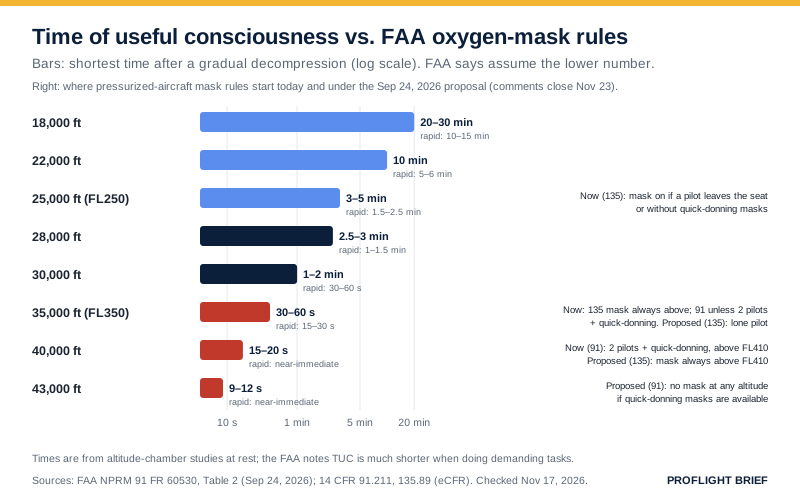
- The FAA said no to FL410 for a lone pilot. It found the time of useful consciousness too short: 15–20 seconds at 40,000 ft after a gradual decompression and “nominal/likely immediate loss of consciousness” after a rapid one. So it proposes FL350 for the lone pilot instead.
- The safety data. The FAA estimates Part 91 and 135 operators flew more than 20 million hours above FL250 between January 2015 and May 2025, with about 200 reported decompression events: 75% from FL260 through FL410 and 25% above FL410. Four were possible rapid or explosive decompressions; two of those ended in accidents.
- ICAO and the military are looser. ICAO Annex 6 requires a quick-donning mask to be available above FL250 but doesn’t require anyone to wear one at a set altitude.
- Cost. The FAA puts an oxygen fill-up at $100 to $400 and estimates savings of $4.7 million to $18.6 million a year for each percentage point of the roughly 4.7 million Part 91/135 turbojet and multi-engine turboprop operations that no longer need servicing. It doesn’t publish a single total.
All figures in this section are from the NPRM (FAA NPRM, Flight Operations: Pilot requirements; Use of oxygen, 91 FR 60530 (Sep 24, 2026)).
Time of useful consciousness
Time of useful consciousness (TUC) is how long you can still think clearly and act (for example, put a mask on) after losing oxygen. It is not the time until you pass out. The FAA’s table (NPRM Table 2):
| Altitude | Gradual decompression | Rapid decompression |
|---|---|---|
| 18,000 ft | 20 to 30 min | 10 to 15 min |
| 22,000 ft | 10 min | 5 to 6 min |
| 25,000 ft | 3 to 5 min | 1.5 to 2.5 min |
| 28,000 ft | 2.5 to 3 min | 1 to 1.5 min |
| 30,000 ft | 1 to 2 min | 30 to 60 s |
| 35,000 ft | 30 to 60 s | 15 to 30 s |
| 40,000 ft | 15 to 20 s | Nominal / likely immediate loss of consciousness |
| 43,000 and 50,000 ft | 9 to 12 s | Nominal / likely immediate loss of consciousness |
The FAA notes these come from altitude-chamber studies with subjects at rest, that TUC was much shorter when subjects did demanding tasks, and it “strongly recommended” assuming the lower number at each altitude.
High-altitude training endorsement
To act as PIC of a pressurized aircraft with a service ceiling or maximum operating altitude (whichever is lower) above 25,000 ft MSL, you need logged ground training and a logbook endorsement covering subjects like hypoxia, duration of consciousness without oxygen and decompression, plus logged flight training in a pressurized aircraft or a representative simulator or FTD (14 CFR 61.31(g) (eCFR)). There are documented-experience exceptions in 61.31(g)(3).
How to comment
- Go to Docket FAA-2026-12145 on Regulations.gov and submit a comment on document FAA-2026-12145-0001 (mail, hand delivery and fax are also listed in the NPRM).
- The FAA says the most helpful comments point to a specific part of the proposal, explain the change you want, and include supporting data.
- Comments are posted publicly without edits, including any personal information you include.
- Submit once. The FAA considers comments received by Nov 23, 2026, and late comments only if it can without expense or delay.
Flying jets or turboprops under Part 135? See our cargo pilot jobs guide and duty and rest rules. Helicopter pilots: HEMS jobs and tour pilot jobs.
Sources
Checked Nov 17, 2026: FAA NPRM, Flight Operations: Pilot requirements; Use of oxygen, 91 FR 60530 (Sep 24, 2026) (preamble sections I, III, IV and VII, Tables 1 and 2, and the proposed regulatory text); Docket FAA-2026-12145 on Regulations.gov (comment count and closing time from the Regulations.gov API); 14 CFR 91.211 (eCFR); 14 CFR 135.89 (eCFR); 14 CFR 135.157 (eCFR); 14 CFR 121.329 (eCFR); 14 CFR 121.333 (eCFR); 14 CFR 61.31(g) (eCFR). eCFR text current as of Nov 13, 2026.
What we couldn’t verify
We didn’t read AC 61-107B directly; the TUC numbers are the FAA’s table in the NPRM, which cites it. We quote section 834 of the 2024 Reauthorization Act as the NPRM describes it, not from the statute. We don’t know when or whether the FAA will finalize the rule, or what it will change after comments. The FAA doesn’t publish a single total cost-savings estimate, only a per-percentage-point range. Individual operators’ oxygen policies (many are stricter than the FAA minimums) and specific aircraft limitations are not covered; your AFM and operations manual control. Part 121 passenger oxygen details in 121.329(c) and 121.333(e) aren’t summarized here.
Looking for employers? Browse the pilot employer & flight school directory.
FAQ
At what altitude do pilots need oxygen under Part 91?
Under 14 CFR 91.211, the required flight crew must use supplemental oxygen above 12,500 ft cabin pressure altitude (up to 14,000 ft) for any portion over 30 minutes, and at all times above 14,000 ft. Above 15,000 ft every occupant must be provided with oxygen.
What are the Part 135 oxygen rules?
Under 14 CFR 135.89(a), each pilot of an unpressurized aircraft must use oxygen continuously above 10,000 ft through 12,000 ft for any portion over 30 minutes, and at all times above 12,000 ft. In pressurized aircraft, the same applies whenever the cabin altitude exceeds 10,000 ft, and mask rules start above FL250.
When does a pilot have to wear an oxygen mask in a pressurized jet?
Today, under Part 91, one pilot at the controls wears a sealed mask above FL350, unless two pilots at the controls each have a quick-donning mask, in which case the requirement starts above FL410. Under Part 135, one pilot wears a mask above FL350, or above FL250 if the pilots lack quick-donning masks or one pilot leaves the seat. Part 121 starts at FL250, with quick-donning exceptions up to FL350 or FL410 depending on aircraft size.
What did the FAA propose on Sep 24, 2026?
Raise the Part 135 two-pilot always-wear mask altitude from FL350 to FL410; raise the Part 135 lone-pilot mask altitude from FL250 to FL350 and apply it to single-pilot flights; and let Part 91 pilots fly at any certified altitude without wearing a mask if each pilot has a quick-donning mask (deleting the rule for when one pilot leaves the controls). Part 121 is unchanged.
When are comments due on the FAA oxygen mask proposal?
Nov 23, 2026, on docket FAA-2026-12145 (Notice No. 26-17, RIN 2120-AM24) at Regulations.gov. Regulations.gov lists 11:59 p.m. ET as the closing time.
Do helicopter pilots need oxygen?
Yes, by altitude, like any aircraft. Most helicopters are unpressurized, so under Part 91 the crew needs oxygen above 12,500 ft for more than 30 minutes and always above 14,000 ft; under Part 135 it starts above 10,000 ft for more than 30 minutes and always above 12,000 ft. The 2026 proposal doesn’t change these unpressurized rules.
What is time of useful consciousness at FL350?
About 30 to 60 seconds after a gradual decompression and 15 to 30 seconds after a rapid one, according to the table in the FAA’s 2026 NPRM. At 40,000 ft it is 15 to 20 seconds (gradual), and a rapid decompression causes likely immediate loss of consciousness.
Related guides
- ADS-B In mandate
- Pilot duty time & rest rules
- FAA ground stops explained
- Pilot in command authority (14 CFR 91.3)
- Pilot mental health & the FAA medical
- Cargo pilot jobs compared
- Direct Entry Captain jobs
- HEMS / air medical pilot jobs
- Helicopter tour pilot jobs
- How to become a flight instructor (CFI)
- Free 2026 Pilot Pay Guide (PDF)
Data checked Nov 2026. Pay and postings change, so verify with the employer. Estimates are labeled.