Guides · Updated
Pilot Duty Time and Rest Rules (2026): FAA Part 117, Part 121 Cargo, Part 135 and HEMS Limits Explained
Part 117 duty-day lookup
Pick your scheduled report time (acclimated local time), crew size and number of flight segments. The tool reads the maximum flight duty period (FDP) and flight time straight from the FAA’s Part 117 tables. It does not handle split duty, reserve or extensions.
Maximum scheduled FDP: 14:00 hours (Table B (unaugmented))
Maximum flight time: 9 hours (Table A)
Rest before it: at least 10 consecutive hours with an 8-hour uninterrupted sleep opportunity, plus 30 consecutive hours free from duty in the past 168 (§117.25).
Cumulative caps: 60 FDP hours in any 168 consecutive hours, 190 in any 672; 100 flight hours in any 672 and 1,000 in any 365 days (§117.23).
If unforeseen circumstances arise before takeoff, the PIC and the airline may extend the FDP by up to 2 hours (an extension of more than 30 minutes only once between rest periods) (§117.19). This lookup is not legal advice and doesn’t replace your airline’s FAA-approved rules, FRMS or contract, which can be stricter.
Why this is in the news
On Oct 26, 2026, the European Cockpit Association published a fatigue survey of 7,200 pilots in 32 countries, prepared by Baines Simmons. 76.8% said they had at least one microsleep while operating an aircraft in the previous four weeks, and 38.8% said they usually or always lacked enough rest to prevent cumulative fatigue. Only 37.2% said they report when unfit or fatigued, and 24.2% said they don’t report and fly anyway (European Cockpit Association (Oct 26, 2026)). BALPA backed the findings and said safety margins can’t hold if pilots are routinely rostered to the upper limits of their flight and duty limits (BALPA (Oct 26, 2026)). Those are European pilots under EASA rules. This guide covers the U.S. rules, quoted from the current eCFR text (up to date as of Oct 23, 2026, checked Oct 27, 2026).
Which rule applies to you?
| Operation | Rule | Flight time per day | Rest | Cumulative flight-time caps |
|---|---|---|---|---|
| Part 121 passenger airlines | Part 117 (14 CFR Part 117 (eCFR)) | 8–9 h with minimum crew (Table A); 13 h with 3 pilots; 17 h with 4 pilots | 10 consecutive h before each FDP with an 8 h sleep opportunity; 30 consecutive h off in any 168 | 100 h in 672 consecutive h; 1,000 h in 365 days. FDP: 60 h in 168, 190 h in 672 |
| Part 121 all-cargo, domestic (unless it opts into Part 117) | §121.471 (14 CFR 121.471 (eCFR)) | 8 h between required rest periods | 9, 10 or 11 consecutive h in the 24 h before a segment ends, by scheduled flight time (can be reduced to 8–9 h with a longer next rest); 24 consecutive h off in any 7 days (scheduled air transportation) | 30 h in 7 days; 100 h a month; 1,000 h a year |
| Part 121 supplemental (airplanes) | §121.503 (14 CFR 121.503 (eCFR)) | 8 h in 24 without a rest period | 16 h rest after flying more than 8 h in 24; 24 consecutive h off once in any 7 days | 100 h in 30 days; 1,000 h a year |
| Part 135 scheduled (commuter) | §135.265 (14 CFR 135.265 (eCFR)) | 8 h in 24 (one pilot) or between rests (two pilots) | 9–11 h, same structure as §121.471; 24 consecutive h off in any 7 days | 34 h in 7 days; 120 h a month; 1,200 h a year |
| Part 135 on-demand, 1–2 pilots (charter, tours, many helicopter jobs) | §135.267 (14 CFR 135.267 (eCFR)) | 8 h (one pilot) or 10 h (two pilots) in 24 consecutive hours | At least 10 consecutive h in the 24 h before the assignment ends; 13 rest periods of 24 consecutive h each calendar quarter | 500 h a quarter; 800 h in two quarters; 1,400 h a year |
| Helicopter air ambulance (HEMES) | §135.271 (14 CFR 135.271 (eCFR)) | 8 h in any 24 of the assignment (unless a medical evacuation is prolonged) | 10 consecutive h before reporting; 8 consecutive h in every 24; after the assignment 12 h (under 48 h) or 16 h (over 48 h); 13 × 24 h off per quarter | 500 h a quarter; 800 h in two quarters; 1,400 h a year |
| Fractional ownership (Part 91 subpart K), 1–2 pilots | §91.1059 (14 CFR 91.1059 (eCFR)) | 8 h one pilot (extension to 9); 10 h two pilots (extension to 12) | 10 h before duty; duty period up to 14 h; 10 h after (12 after an extension; 14/18 after multi-time-zone flights) | 500 h a quarter; 800 h in two quarters; 1,400 h a year |
Part 117 applies to Part 121 passenger operations, and a cargo carrier may choose to run its operations under Part 117 instead of the older subparts (§117.1(d)). Flag and supplemental Part 121 operations have their own subparts (R and S). Outside subpart K, Part 91 (private and corporate flying) has no pilot flight, duty or rest limit sections, so any limits there come from the company or its insurer.
Part 117: the airline duty day
A flight duty period (FDP) starts when you report for duty intending to fly and ends when the aircraft is parked after the last flight. Deadhead, simulator training and airport/standby reserve count as part of the FDP if they happen before or between flights without a required rest break (§117.3). The maximum depends on when you report (in acclimated local time) and how many segments you fly:
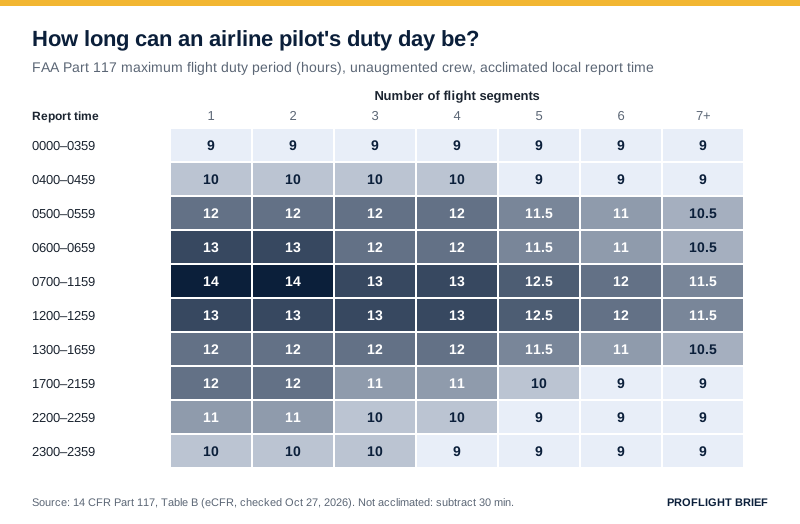
- Best case: 14 hours for a report between 07:00 and 11:59 with 1–2 segments. Worst case: 9 hours for a report between 00:00 and 03:59, regardless of segments (Table B).
- Not acclimated: subtract 30 minutes, and use local time where you were last acclimated (§117.13(b)). You become acclimated after 72 hours in a theater or 36 consecutive hours off duty (§117.3).
- Flight time with minimum crew: 8 hours for a 00:00–04:59 or 20:00–23:59 report, 9 hours for 05:00–19:59 (Table A).
- Augmented crews (3 or 4 pilots) get 13 to 19 hours depending on the onboard rest facility class (Table C), with no more than 3 segments. The pilot flying the landing must get 2 consecutive hours of in-flight rest in the second half of the FDP (§117.17).
- Split duty: a scheduled rest of at least 3 hours in a suitable accommodation between 22:00 and 05:00 doesn’t count toward the FDP, but FDP plus that rest can’t exceed 14 hours (§117.15).
- Nights: no more than 3 consecutive FDPs that infringe on the window of circadian low (02:00–05:59), or 5 if you get at least a 2-hour rest opportunity in a suitable accommodation during each one (§117.27).
- Short-call reserve: the reserve availability period can’t exceed 14 hours, and reserve plus FDP can’t exceed the Table B limit plus 4 hours or 16 hours, whichever is less (§117.21).
Extensions (the U.S. version of commander’s discretion)
If unforeseen operational circumstances arise before takeoff, the PIC and the airline may extend the maximum FDP by up to 2 hours. An extension of more than 30 minutes can happen only once before the next required rest, and the airline must report any extension over 30 minutes to the FAA within 10 days (§117.19(a)). After takeoff, the FDP can be extended as far as needed to land safely at the destination or alternate (§117.19(b)). The ECA survey found 69.1% of European pilots worried about consequences if they refused an extension (European Cockpit Association (Oct 26, 2026)). Under Part 117, an extension needs the PIC’s agreement; the rule says “the pilot in command and the certificate holder may extend.”
Reporting fatigued
You must report for each FDP rested and prepared, and you must affirmatively state you are fit for duty before flight. If you report yourself too fatigued, the airline can’t assign you to the FDP or let you continue it (§117.5). If you can see your rest period won’t give you 8 uninterrupted hours of sleep opportunity, you must tell the airline, and you can’t report for the FDP until you get the required rest (§117.25(f)). Airlines that want to exceed any Part 117 limit need an FAA-approved Fatigue Risk Management System, which must include a fatigue reporting system (§117.7).
Part 135 and helicopter jobs
Most charter, tour and utility helicopter flying for hire is on-demand Part 135, so §135.267 applies. The daily limit is flight time, not duty: 8 hours for a single pilot or 10 for two pilots in any 24 consecutive hours, counting any other commercial flying. Every assignment must include at least 10 consecutive hours of rest in the 24 hours before its planned completion (§135.267(b), (d)). §135.267(c) describes a regularly assigned duty period of no more than 14 hours with at least 10 hours of rest before and after, which is where the “14-hour duty day” in charter comes from. If weather or other circumstances beyond anyone’s control push you past the daily flight-time limit, you need 11, 12 or 16 hours of rest depending on how far over you went (§135.267(e)).
HEMS has its own section, §135.271. You need 10 consecutive hours of rest before reporting to the hospital, and no more than 8 hours of flight time in any 24 hours of the assignment unless a medical evacuation is prolonged. If you go over, you must be relieved when that flight ends. You need at least 8 consecutive hours of rest in every 24 hours, an adequate place of rest at or near the hospital, and no other duties. An assignment can’t exceed 72 consecutive hours at the hospital. Afterward you need 12 consecutive hours of rest for an assignment under 48 hours, or 16 for one over 48 hours. Large operators schedule well inside this: Air Methods says its pilots typically work 7 on / 7 off with 12-hour shifts (Air Methods pilot careers; see HEMS pilot jobs).
Your contract can be stricter
These are FAA minimums. Union contracts and company manuals often add their own duty rigs, minimum days off and rest buffers, and credit rigs change what a long day pays. See how duty and trip rigs affect pay in the pilot pay calculator, and check when your contract opens in the pilot contract tracker. Comparing employers? Browse the pilot employer directory and the Texas pilot jobs hub.
Looking for employers? Browse the pilot employer & flight school directory.
FAQ
What is the maximum duty day for an airline pilot?
Under 14 CFR Part 117 Table B, the maximum scheduled flight duty period for an unaugmented crew is 9 to 14 hours, depending on report time and number of segments. The longest is 14 hours for a 07:00–11:59 report with 1–2 segments. Augmented crews can go up to 19 hours (4 pilots, Class 1 rest facility, Table C).
How much rest do airline pilots get between flights?
At least 10 consecutive hours before any reserve or flight duty period, including a minimum of 8 uninterrupted hours of sleep opportunity, plus at least 30 consecutive hours free from duty in any 168 consecutive hours (14 CFR 117.25).
How many hours can a pilot fly in a month?
Part 117 caps flight time at 100 hours in any 672 consecutive hours (28 days) and 1,000 hours in any 365 consecutive days. Domestic all-cargo carriers under §121.471 are limited to 100 hours a calendar month, and Part 135 commuter pilots to 120 hours a month (§135.265).
What are the Part 135 duty limits for charter and helicopter pilots?
Under 14 CFR 135.267, total flight time can’t exceed 8 hours for a single pilot or 10 hours for two pilots in any 24 consecutive hours, and each assignment must include at least 10 consecutive hours of rest in the 24 hours before it ends. Quarterly and annual caps are 500, 800 (two quarters) and 1,400 hours.
What are the duty and rest rules for HEMS pilots?
Under 14 CFR 135.271, HEMS pilots need 10 consecutive hours of rest before reporting, may fly no more than 8 hours in any 24 hours of the assignment (unless a medical evacuation is prolonged), must get at least 8 consecutive hours of rest in every 24 hours, and can’t stay on an assignment more than 72 consecutive hours.
Do cargo pilots fall under Part 117?
Not automatically. Part 117 covers Part 121 passenger operations. All-cargo carriers can choose to operate under Part 117 (§117.1(d)); otherwise the older Part 121 subparts apply, such as §121.471 for domestic operations.
Can a pilot refuse to fly when fatigued?
Under Part 117, an airline may not assign or let a pilot continue a flight duty period if the pilot has reported too fatigued to safely perform the duties (§117.5), and each pilot must affirmatively state fitness for duty before flight.
Related guides
- HEMS / air medical pilot jobs
- Pilot pay calculator
- Pilot contract tracker
- Airline pilot pay
- Helicopter pilot salary
- Regional FO pay
- Free 2026 Pilot Pay Guide (PDF)
Data checked Oct 2026. Pay and postings change, so verify with the employer. Estimates are labeled.