Guides · Updated
Pilot Mental Health and the FAA Medical (2026): Therapy, Antidepressants and the Mental Health in Aviation Act
If you are in crisis or thinking about suicide, call or text 988 (Suicide & Crisis Lifeline, U.S.). The FAA tells pilots to self-ground for suicidal thoughts, and calls self-grounding “a sign of good insight” (FAA Therapy, Psychotherapy and Counseling FAQs (updated May 27, 2026)).
Why this is in the news
Two bills to change how the FAA handles pilot mental health passed the Senate by unanimous consent on Sep 24, 2026: the John A. Hauser Mental Health in Aviation Act (S. 3257, John A. Hauser Mental Health in Aviation Act (Congress.gov)) and the Aviation Medication Transparency Act (S. 3258, Aviation Medication Transparency Act of 2026 (Congress.gov)). Both were received in the House and held at the desk on Oct 1, 2026, which is still the latest action. The House had already passed its own Mental Health in Aviation Act, H.R. 2591, by voice vote on Sep 8, 2025 (H.R. 2591, Mental Health in Aviation Act of 2025 (Congress.gov)), but the two texts differ, so one chamber has to pass the other’s version before anything goes to the President. The 119th Congress ends on Jan 3, 2027; a bill not enacted by then has to be reintroduced. ALPA, which co-chaired the FAA committee whose recommendations the bill would carry out, backs it (ALPA (Sep 25, 2026)).
The rules today
- Self-grounding (14 CFR 61.53). You may not act as PIC or a required crewmember while you know or have reason to know of a medical condition, or are taking medication or treatment, that makes you unable to meet your medical standard (14 CFR 61.53 (eCFR)).
- Disqualifying mental conditions (14 CFR 67.107 for first class; 67.207 and 67.307 for second and third). An established history or diagnosis of a personality disorder severe enough to have repeatedly shown itself by overt acts, a psychosis, a bipolar disorder, or substance dependence (unless the Federal Air Surgeon accepts evidence of recovery including at least 2 years of total abstinence); substance abuse within 2 years; or any other mental condition the Federal Air Surgeon finds makes you unable to safely use the certificate (14 CFR 67.107 (eCFR)). Depression and anxiety are not on the named list; they fall under that last case-by-case clause.
- Therapy. The FAA’s FAQ (updated May 27, 2026) says therapy, psychotherapy and counseling are the same thing for FAA purposes and are “compatible with both an unrestricted medical certificate and special issuance.” Pilots don’t have to report immediately; you report on your next medical application. All visits to licensed providers go on MedXPress, but educational and religious counseling (unless the clergy member is a licensed counselor), couples counseling (unless it led to a referral for individual therapy) and EAP consultations (unless they led to a referral for psychiatric evaluation or treatment) need not be reported. A therapy visit does not automatically create a diagnosis, and the FAA usually sees only a brief summary, not your records (FAA Therapy, Psychotherapy and Counseling FAQs (updated May 27, 2026)).
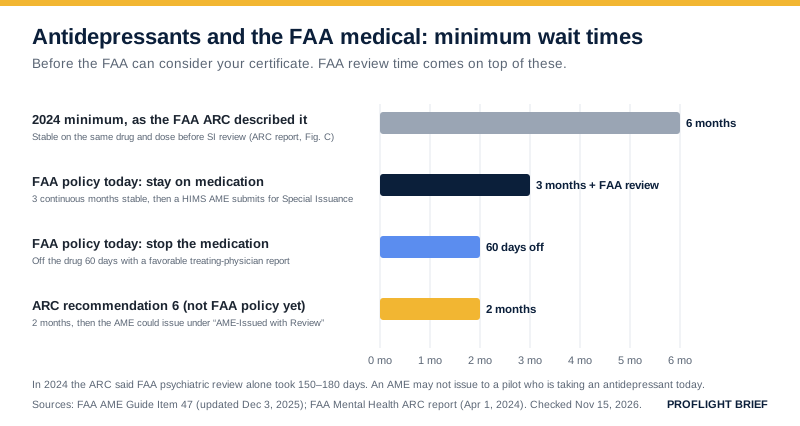
- Antidepressants. The AME Guide’s Antidepressant Protocol (renamed from the SSRI Protocol on Apr 24, 2024) lets the FAA consider a certificate case by case; the AME may not issue. You need a qualifying diagnosis (mild-to-moderate major depressive disorder, dysthymic disorder, adjustment disorder with depressed mood, or a non-depression condition the drug treats), at least 3 continuous months clinically stable on a stable dose with no aeromedically significant side effects, one listed drug used alone, and none of the rule-outs: psychosis, suicidal ideation, electroconvulsive therapy, multiple SSRIs at once, or prior multi-drug psychiatric treatment. A HIMS AME then evaluates you and submits a Special Issuance package. If you stop the drug instead, you can reapply for regular issuance after at least 60 days off it with a favorable treating-physician report (FAA AME Guide, Item 47: Use of Antidepressant Medications).
Antidepressants the FAA lists
| Status | Medications (FAA table updated Aug 27, 2025) |
|---|---|
| Conditionally acceptable with Special Issuance (single agent only) | SSRIs: citalopram (Celexa), escitalopram (Lexapro), fluoxetine (Prozac, Sarafem), sertraline (Zoloft). SNRIs: desvenlafaxine (Pristiq), duloxetine (Cymbalta), venlafaxine (Effexor). Bupropion (Wellbutrin) SR/ER only. Vilazodone (Viibryd). |
| Unacceptable (alone or in any combination) | Fluvoxamine (Luvox), paroxetine (Paxil), levomilnacipran (Fetzima), bupropion IR, vortioxetine (Trintellix), esketamine (Spravato), all tricyclics, all MAOIs. |
Source: FAA Antidepressant Medications table (updated Aug 27, 2025). Don’t start, stop or switch a medication to fit this list without your prescriber; the FAA itself says “see your treating physician … and get healthy” first (FAA Airman Information: SSRI Initial Certification (updated Aug 26, 2026)).
How long it takes (and why pilots stay quiet)
The FAA’s own rulemaking committee (ARC) reported on Apr 1, 2024 that about 20% of mental health diagnoses are initially disqualifying, leaving the pilot or controller without a certificate until the case is resolved, while only about 0.1% of applicants who disclose any health issue and complete the process are ultimately denied. Its notional timeline assumed a 180-day minimum on a stable medication, and said FAA psychiatrist review was then taking 150 to 180 days. The ARC found that the time cost, not the denial rate, drives pilots to avoid care or stop medication (FAA Mental Health & Aviation Medical Clearances ARC report (Apr 1, 2024)). ALPA says a pilot starting an antidepressant can wait more than a year for an initial authorization (ALPA (Sep 25, 2026)). The FAA’s Airman Information sheet warns that partial or incomplete packages will not be reviewed and asks for updated HIMS AME and psychiatrist reports every 6 months while a case is pending (FAA Airman Information: SSRI Initial Certification (updated Aug 26, 2026)).
What the 2024 FAA committee recommended
The ARC made 24 recommendations (FAA Mental Health & Aviation Medical Clearances ARC report (Apr 1, 2024)). The ones pilots ask about most:
- REC1: stop requiring disclosure of talk therapy on the medical application.
- REC2: a non-punitive pathway to report past, undisclosed mental health conditions and medications.
- REC3–4: expand peer support programs, and let pilots working with one get mental health care with less restrictive reporting and grounding requirements.
- REC6: for uncomplicated depression or anxiety on one approved antidepressant, cut the wait from six months to two months and let the AME issue under an “AME-Issued with Review” model, as the FAA already does for sleep apnea.
- REC7–8: study whether pilots with ADHD can fly on acceptable medication, and loosen the PTSD criteria so AMEs can issue for mild cases with FAA review.
- REC19: more mental health training and quality assurance for AMEs.
- REC23–24: push Congress to extend mental health parity to disability insurance, and have employers offer disability coverage that includes mental health.
Some of this has moved since 2024: the AME Guide now says 3 months rather than six, more drug classes were added in April 2024, and the FAA’s 2026 therapy FAQ says therapy is compatible with certification. But therapy visits to licensed providers still have to be listed on MedXPress, and AMEs still can’t issue to pilots on antidepressants (FAA Therapy, Psychotherapy and Counseling FAQs (updated May 27, 2026); FAA AME Guide, Item 47: Use of Antidepressant Medications).
House vs Senate: what the bill would do
| Provision | House: H.R. 2591 (passed Sep 8, 2025) | Senate: S. 3257 (passed Sep 24, 2026) |
|---|---|---|
| Name | Mental Health in Aviation Act of 2025 | John A. Hauser Mental Health in Aviation Act |
| Rewrite Part 67 and guidance to encourage seeking help and disclosing it | Within 2 years | Within 18 months, plus “relevant guidance” |
| Carry out the 2024 ARC’s recommendations | Within 2 years, “to the greatest extent practicable”; justify any not adopted | Within 2 years, “as appropriate”; REC6 must be backed by clinical studies (any new studies done within 1 year); justify any not adopted within 90 days |
| FAA task group (FAA Reauthorization Act of 2024, sec. 411) recommendations | FAA “shall take such actions as are necessary” to implement them within 180 days of the report | FAA “may take action, as appropriate” within 180 days; must justify any not implemented within 90 days |
| Review of mental health Special Issuance | Every year | Starts 180 days after the first task-group report; yearly for 2 years, then every 3 years |
| Money for more AMEs, HIMS AMEs and psychiatrists, and the Special Issuance backlog | $13,740,000 a year set aside, FY2026–2028 | Not more than $15,000,000 a year, FY2026–2028 (also covers enhanced AME mental health training) |
| Public campaign against stigma | $1,500,000 a year set aside, FY2026–2028 | FY2026–2028, posted at AME offices and shared with airlines, flight schools and airports; no dollar figure |
| Status (Congress.gov, checked Nov 15, 2026) | In Senate Commerce since Sep 9, 2025 | Held at the House desk since Oct 1, 2026 |
Sources: H.R. 2591 text as passed by the House (GovInfo); S. 3257 text as passed by the Senate (GovInfo); H.R. 2591, Mental Health in Aviation Act of 2025 (Congress.gov); S. 3257, John A. Hauser Mental Health in Aviation Act (Congress.gov).
The companion bill: a public medication list
The Aviation Medication Transparency Act (S. 3258, Sen. Duckworth) would make the FAA publish, within 1 year of enactment, a public list of prescription and over-the-counter medications it allows, with contraindications, whether FAA review is needed, the “Do Not Issue” and “Do Not Fly” lists and, if practicable, how long you must stay off duty to stabilize on a drug. The list would also appear in MedXPress when you first apply, and the FAA would update it within a year of publishing it and whenever its medical guidance changes. It passed the Senate by unanimous consent on Sep 24, 2026 and has been held at the House desk since Oct 1, 2026 (S. 3258, Aviation Medication Transparency Act of 2026 (Congress.gov); S. 3258 text as passed by the Senate (GovInfo)).
What to do now if you’re struggling
- Get care first. The FAA’s own guidance says to see your treating physician or therapist and “get healthy” (FAA Airman Information: SSRI Initial Certification (updated Aug 26, 2026)).
- Decide whether you’re fit today. Under 61.53 and the FAA FAQ, ground yourself for major depression, severe anxiety or panic, suicidal thoughts, or anything that impairs concentration, judgment or alertness (FAA Therapy, Psychotherapy and Counseling FAQs (updated May 27, 2026)).
- Talk to your union or company peer support program, or your AME. The FAA FAQ names Pilot Peer Support Programs as a place to start.
- If medication is part of treatment, find a HIMS AME early and gather all treatment records; partial packages aren’t reviewed (FAA Airman Information: SSRI Initial Certification (updated Aug 26, 2026)).
- Report honestly on your next MedXPress. The ARC found that almost nobody who completes the process is ultimately denied (FAA Mental Health & Aviation Medical Clearances ARC report (Apr 1, 2024)).
Sources
Checked Nov 15, 2026: S. 3257, John A. Hauser Mental Health in Aviation Act (Congress.gov); S. 3257 text as passed by the Senate (GovInfo); H.R. 2591, Mental Health in Aviation Act of 2025 (Congress.gov); H.R. 2591 text as passed by the House (GovInfo); S. 3258, Aviation Medication Transparency Act of 2026 (Congress.gov); S. 3258 text as passed by the Senate (GovInfo); FAA Mental Health & Aviation Medical Clearances ARC report (Apr 1, 2024); FAA AME Guide, Item 47: Use of Antidepressant Medications; FAA Antidepressant Medications table (updated Aug 27, 2025); FAA Airman Information: SSRI Initial Certification (updated Aug 26, 2026); FAA Therapy, Psychotherapy and Counseling FAQs (updated May 27, 2026); 14 CFR 61.53 (eCFR); 14 CFR 67.107 (eCFR); ALPA (Sep 25, 2026).
What we couldn’t verify
The FAA’s current average Special Issuance or psychiatric review time is not published on the pages we read; the 150–180 day figure is the ARC’s 2024 number. We didn’t find an FAA page listing which of the 24 ARC recommendations it has formally adopted. Dates when the FAA moved from six months to three months: not published on the AME Guide page we read. House floor scheduling for S. 3257: not published. This guide is not medical or legal advice; talk to your AME or a HIMS AME about your own case.
Looking for employers? Browse the pilot employer & flight school directory.
FAQ
Can a pilot see a therapist without losing their FAA medical?
Yes. The FAA’s therapy FAQ (updated May 27, 2026) says psychotherapy is compatible with an unrestricted medical certificate and with special issuance. You report visits to licensed providers on your next MedXPress application, not immediately; a diagnosis, if one is made, is then reviewed by the AME or the FAA.
Can pilots take antidepressants?
Yes, through Special Issuance only. The drug must be one of nine FAA-listed medications (such as sertraline, escitalopram, fluoxetine, citalopram, duloxetine, venlafaxine, desvenlafaxine, bupropion SR/ER or vilazodone), used alone, after at least 3 continuous months stable, with a HIMS AME evaluation. A regular AME may not issue.
What is the Mental Health in Aviation Act?
A bill requiring the FAA to update its medical rules to encourage pilots and controllers to seek help and disclose it, implement its 2024 mental health rulemaking committee’s recommendations within 2 years, review Special Issuance regularly and fund more AMEs. The House passed H.R. 2591 on Sep 8, 2025; the Senate passed S. 3257 on Sep 24, 2026. It is not law as of Nov 15, 2026.
Do I have to report counseling to the FAA?
Visits to licensed providers, including therapists and counselors, go on MedXPress. The FAA says educational and religious counseling, couples counseling (unless it led to a referral for individual therapy) and EAP consultations (unless they led to a psychiatric referral) need not be reported.
How long does the FAA take to approve a pilot on an antidepressant?
The minimum is 3 months stable on the medication before a HIMS AME can submit, plus FAA review time. The FAA doesn’t publish a current review time; its 2024 rulemaking committee said psychiatric review alone took 150 to 180 days, and ALPA says initial authorization can take more than a year.
What happens if the House doesn’t pass the Senate bill?
The 119th Congress ends on Jan 3, 2027. A bill that isn’t enacted by then dies and has to be reintroduced in the next Congress. The House version (H.R. 2591) has been in Senate Commerce since Sep 9, 2025, and the Senate version (S. 3257) has been held at the House desk since Oct 1, 2026.
Related guides
- FAA ground stops explained
- Pilot in command authority (14 CFR 91.3)
- Pilot duty time & rest rules
- FAA pilot jobs (Flight Test & ASI)
- How to become a flight instructor (CFI)
- Airline cadet programs compared
- Hours to ATP
- Pilot contract tracker
- Free 2026 Pilot Pay Guide (PDF)
Data checked Nov 2026. Pay and postings change, so verify with the employer. Estimates are labeled.