Guides · Updated
ADS-B In Mandate (2026): What Congress Agreed, Who Must Equip, and the Dec 31, 2031 Deadline
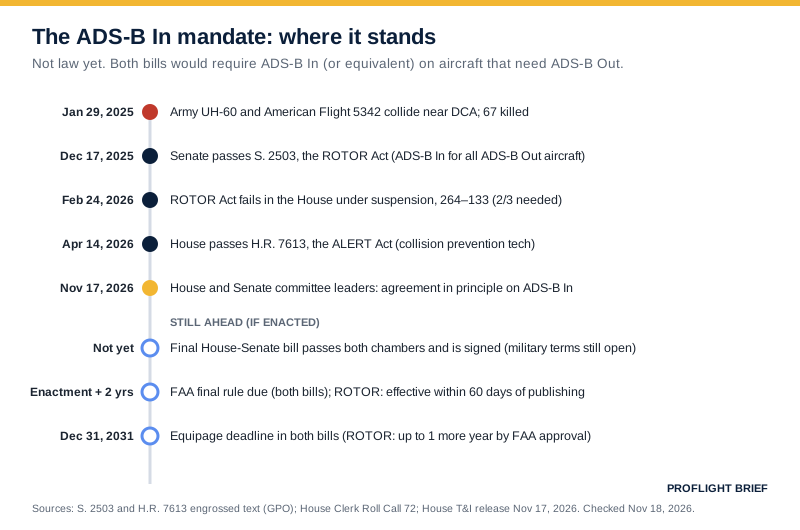
Status on Nov 18, 2026: agreement in principle, not law. The final House-Senate text hasn’t been published. Below we explain what the two bills that are being merged say, because the final bill will be built from them. We’ll update this page when the text is released or the bill passes (House T&I Committee release, Nov 17, 2026).
What was agreed on Nov 17, 2026
- Who: House T&I Chairman Sam Graves and Ranking Member Rick Larsen, and Senate Commerce Chairman Ted Cruz and Ranking Member Maria Cantwell.
- What: a “bipartisan, bicameral agreement in principle on the civil aviation provisions” of the safety legislation addressing the NTSB’s recommendations from the DCA midair collision investigation.
- The ADS-B In piece, in Cruz’s words: “all aircraft required to broadcast their location via ADS-B Out will now be mandated to receive those same signals through ADS-B In.”
- Not settled: “a few details are still being worked out with the House and Senate Armed Services Committees” (Cruz). Cantwell: “We need a comprehensive bill that holds everybody to the same standards.” FLYING reports she said there is no agreement yet on the military provisions (FLYING (Nov 18, 2026)).
- Goal: a final bill signed before the 119th Congress ends.
Source for all quotes: House T&I Committee release, Nov 17, 2026.
Who would have to equip
Both bills tie the requirement to ADS-B Out. If your aircraft must have ADS-B Out under 14 CFR 91.225 (eCFR), it would need ADS-B In (or an approved alternative). Today 91.225 requires ADS-B Out, with exceptions, in:
- Class A airspace (91.225(a)) and Class B and C airspace;
- within 30 nm of the Appendix D, section 1 airports (the Mode C veil), from the surface to 10,000 ft MSL;
- above the ceiling and within the lateral limits of Class B or C airspace, up to 10,000 ft MSL;
- Class E airspace in the 48 contiguous states and DC at and above 10,000 ft MSL, excluding the airspace at and below 2,500 ft AGL;
- Class E airspace at and above 3,000 ft MSL over the Gulf of Mexico out to 12 nm from the U.S. coast.
Aircraft never certificated with an engine-driven electrical system (such as balloons and gliders) have exceptions under 91.225(e). If you fly only where ADS-B Out isn’t required and your aircraft isn’t required to have it, neither bill’s ADS-B In rule would reach you.
Senate ROTOR Act vs. House ALERT Act
| ROTOR Act (S. 2503) | ALERT Act (H.R. 7613) | |
|---|---|---|
| Status | Passed the Senate Dec 17, 2025. Failed in the House Feb 24, 2026 under suspension of the rules, 264–133 (two-thirds needed). | Passed the House Apr 14, 2026. |
| Who must equip | Any aircraft (except drones) required to have ADS-B Out under 91.225. | Non-military aircraft required to have ADS-B Out under 91.225 (“covered aircraft”). Aircraft already required to have TCAS get an ACAS Xa track instead (sec. 102). Limited- and experimental-category aircraft can get ATC deviations, as with ADS-B Out. |
| What equipment | ADS-B In that shows other aircraft’s location and gives traffic advisories, with visual and aural alerting in the air and on the airport surface. | “Collision prevention technology”: ADS-B In that gives traffic awareness and advisories, with audible alerts. |
| FAA final rule due | 2 years after enactment; effective within 60 days of publication. | 2 years after enactment. |
| Equipage deadline | Dec 31, 2031. Operators can apply for up to 1 extra year if the FAA finds it’s needed to avoid a significant disruption to air transportation. | Effective date no later than Dec 31, 2031. |
| Cheaper option | For aircraft under 12,500 lb max takeoff weight flying Part 91, the FAA must set a low-cost alternative and consider portable ADS-B In receivers and EFB or panel displays. | The FAA must allow any technology, including portable ADS-B In receivers shown on a portable device, EFB or panel display, if it gives an equivalent level of safety. |
| Cost presumption | The rule must presume, absent clear and compelling evidence, that ADS-B In is cost beneficial and improves safety. | Not in the House text. |
| Helicopters | Same rule as everyone with ADS-B Out; FAA must publish an ACAS-X action plan within 180 days, including rotorcraft. | Non-military helicopters and powered-lift in Class B airspace: FAA to finalize ACAS Xr standards by Dec 31, 2026 and a rulemaking committee to consider requiring ACAS Xr; collision prevention tech by Dec 31, 2031 at the latest (sec. 103). |
| Airliners and TCAS aircraft | Covered by the same ADS-B In rule. | Rulemaking to require ACAS Xa that uses ADS-B In plus transponder data, with deadlines no later than Dec 31, 2031 for new and existing aircraft (sec. 102). |
| Military ADS-B Out | “Sensitive government mission” exception narrowed: not routine, unclassified or proficiency flights (sec. 3). | Separate Defense Department title (sec. 201). |
Sources: S. 2503, ROTOR Act, as passed by the Senate (Congress.gov) (secs. 2–4); H.R. 7613, ALERT Act of 2026, as passed by the House (Congress.gov) (secs. 2, 102–104, 201); House Clerk Roll Call 72 (Feb 24, 2026).
What it means for you
- Light GA, Part 91, under 12,500 lb: both bills point to portable ADS-B In receivers and EFB displays as acceptable if the FAA approves them. Which devices qualify won’t be known until the FAA writes the rule and guidance.
- Part 135 and heavier aircraft: the low-cost carve-out in the Senate bill covers only Part 91 aircraft under 12,500 lb, so Part 135 operators should expect installed equipment that meets FAA performance standards.
- Helicopter pilots: HEMS, tour, news and utility helicopters that fly in ADS-B Out airspace would be covered. The House bill adds an ACAS Xr track for civil helicopters in Class B airspace. See our HEMS jobs and helicopter tour jobs guides.
- Airline pilots: the House bill would move TCAS-equipped aircraft to ACAS Xa using ADS-B In, with new aural traffic alerts that include clock position, relative altitude, range and vertical trend.
- Timing: nothing changes on your airplane today. The earliest you’d see an FAA rule is after the bill is signed, and the backstop is Dec 31, 2031.
What’s still open
- The final text, including which chamber’s approach wins on equipment, deadlines and the light-aircraft option.
- Military provisions (Armed Services Committees).
- When each chamber votes.
- Cost: neither bill states an equipment cost, and we haven’t found an official estimate for the agreed version.
Related: our FAA ground stop explainer covers the Nov 13 outage that is also driving this week’s ATC funding debate, and our oxygen rules guide covers the FAA’s other open rulemaking (comments close Nov 23).
Sources
Checked Nov 18, 2026: House T&I Committee release, Nov 17, 2026; S. 2503, ROTOR Act, as passed by the Senate (Congress.gov) (engrossed text, GPO); H.R. 7613, ALERT Act of 2026, as passed by the House (Congress.gov) (engrossed text, GPO); House Clerk Roll Call 72 (Feb 24, 2026); 14 CFR 91.225 (eCFR) (eCFR, Title 14 current as of Nov 13, 2026); FLYING (Nov 18, 2026) (Cantwell’s comment on military provisions).
What we couldn’t verify
The agreed text hasn’t been published, so we can’t say which version’s details (light-aircraft option, extensions, helicopter ACAS Xr) survive. We didn’t find an official equipment cost estimate. We report Cantwell’s remark about military provisions from FLYING, not a transcript.
Looking for employers? Browse the pilot employer & flight school directory.
FAQ
Is ADS-B In now required?
No. As of Nov 18, 2026, it is an agreement in principle between House and Senate committee leaders (announced Nov 17, 2026). It needs a final bill passed by both chambers and signed, then an FAA rule.
When is the ADS-B In deadline?
Both bills set Dec 31, 2031 as the latest equipage deadline. The Senate’s ROTOR Act lets operators apply for up to one more year if the FAA finds it’s needed to avoid a significant disruption to air transportation.
Which aircraft would need ADS-B In?
Aircraft required to have ADS-B Out under 14 CFR 91.225, which covers flying in Class A, B and C airspace, inside the 30 nm Mode C veils, and in Class E at and above 10,000 ft MSL (excluding 2,500 ft AGL and below), among other areas.
Will a portable ADS-B receiver count?
Possibly, for light aircraft. The ROTOR Act tells the FAA to set a low-cost alternative for aircraft under 12,500 lb flying Part 91 and to consider portable ADS-B In receivers and EFB displays; the ALERT Act says the FAA must allow portable receivers if they give an equivalent level of safety. The FAA would decide what qualifies.
Does the ADS-B In mandate apply to helicopters?
Yes, if the helicopter must have ADS-B Out. The House bill also starts work on requiring ACAS Xr collision avoidance for civil helicopters and powered-lift aircraft in Class B airspace.
What is the ROTOR Act?
S. 2503, the Rotorcraft Operations Transparency and Oversight Reform Act. It passed the Senate on Dec 17, 2025, but failed in the House on Feb 24, 2026 (264–133, short of the two-thirds needed under suspension). Its text is now being merged with the House’s ALERT Act (H.R. 7613).
Related guides
- FAA ground stops explained
- Pilot oxygen requirements
- HEMS / air medical pilot jobs
- Helicopter tour pilot jobs
- Pilot in command authority (14 CFR 91.3)
- How to become a flight instructor (CFI)
- Become a helicopter pilot
- eVTOL / powered-lift pilot
- Free 2026 Pilot Pay Guide (PDF)
Data checked Nov 2026. Pay and postings change, so verify with the employer. Estimates are labeled.