Guides · Updated
Runway Incursions and the FAA’s New Runway-Crossing Callout (InFO 26016): The Rules, the Data and What to Say Before You Cross
Updated Nov 21, 2026. This page explains the FAA’s new runway-crossing callout guidance, the rules it sits on top of, and what the data say about runway incursions. Every fact links to the FAA, the NTSB or the DOT Inspector General. It isn’t training or legal advice; your operator’s SOPs and your clearance govern what you do on the airport.
What the FAA asked for on Nov 18, 2026
FAA InFO 26016 (Nov 18, 2026), from Flight Standards, makes two recommendations:
- The callout: Part 91K, 121 and 135 operators should “update their SOPs to require flight crews announce the runway they are about to cross, as indicated by signage, unless an aural advisory system or equivalent technology is in place.”
- The SMS piece: operators subject to 14 CFR Part 5, or with a voluntary SMS, “should identify and mitigate safety hazards associated with flight crew surface navigation errors that may occur while multitasking in taxi operations and consider human factors principles.”
It is guidance only. In the InFO’s own words, its content “is not legally binding,” and “conformity with the guidance document is voluntary only.” The FAA says the callout “serves as a double-check mechanism, confirming intended actions and preventing misunderstandings regarding clearances,” and that runway incursions “have decreased” but “remain a serious risk.”
Where it comes from: the NTSB asked for exactly this in 2024. Recommendation A-24-2 asked the FAA to encourage Part 91K, 135 and 121 operators to add “a procedural crosscheck that requires flight crews to verbalize the number of a runway they are about to cross, as indicated by runway signs, unless an installed automated system already provides an aural advisory.” A-24-3 asked the FAA to encourage Part 121 operators to use their SMS to catch taxi errors from concurrent tasks (NTSB report AIR-24-01 (May 29, 2024)). The InFO widens that second item to any operator with an SMS.
What happened at JFK on Jan 13, 2023
From the NTSB’s final report (NTSB report AIR-24-01 (May 29, 2024)):
- American 106, a Boeing 777-200 bound for London, was told to taxi to runway 4L via taxiways B and K and to cross runway 31L. The captain didn’t turn right onto K, continued on B, turned onto J and crossed runway 4L.
- Delta 1943, a 737-900 bound for Santo Domingo, had just started its takeoff roll on 4L. The tower’s ASDE-X alerted the controller, who cancelled Delta’s takeoff clearance. Delta rejected the takeoff at a maximum groundspeed of about 105 knots, about 2,300 ft from the taxiway J intersection. When the 777 cleared the runway, the 737 had slowed to 49 knots and was 1,000 ft away. Nobody was hurt (6 crew and 153 passengers on Delta; 12 crew and 137 passengers on American).
- The crew did a visual check before crossing: the captain called “clear left” and the first officer “clear right.” What was missing was a check of which runway it was.
- Probable cause: the crew’s “surface navigation error due to distractions caused by their performance of concurrent operational tasks during taxi,” with contributing factors including the tower team not catching the deviation, runway status lights that lit “too late,” and American’s lack of risk controls for concurrent crew tasks. The cockpit voice recording had been overwritten.
The callout in practice
The FAA’s taxi advisory circular for multi-pilot crews already asked for verbal calls at hold short lines: “When approaching any hold short line, verbalize ‘approaching (specific runway number) hold short line,’” then scan left and right “including the full length of the runway and its approach paths” and “coordinate verbally (e.g., ‘clear right/left’…)” (AC 120-74B, Flightcrew Procedures During Taxi Operations, active, dated Jul 30, 2012). The same AC says heads-down time “should only take place when the aircraft is taxiing straight ahead or stopped… with no upcoming hold short lines or hot spots.”
InFO 26016 adds the runway number as shown on the sign at the moment you cross. A crew could tie it together like this (our example, not FAA wording): read back “cross runway 31L at Kilo”; approaching the line, “approaching 31L hold short line”; at the red sign, read the number on it, confirm it matches the clearance, then “clear left, clear right, crossing 31L.” If the sign doesn’t match the clearance, stop and ask.
Single-pilot crews: AC 120-74B points single-pilot Part 91 and 135 pilots to AC 91-73B, Single Pilot and Flight School Taxi Procedures. The InFO doesn’t say how a single pilot should “announce” a crossing.
The rules that haven’t changed
- Clearance required: at an airport with an operating control tower, “no person may… operate an aircraft on a runway or taxiway, or take off or land an aircraft, unless an appropriate clearance is received from ATC” (14 CFR 91.129(i)).
- Every runway, explicitly: “A clearance must be obtained prior to crossing any runway. ATC will issue an explicit clearance for all runway crossings.” Being assigned a takeoff runway “does not authorize the aircraft to ‘enter’ or ‘cross’ the assigned departure runway at any point,” and ATC won’t use the word “cleared” for taxi (AIM 4-3-17 and 4-3-18, 4-3-18).
- Read back: pilots should always read back the runway assignment, any clearance to enter a specific runway, and any instruction to hold short of a runway or line up and wait. ATC is required to get a readback of runway hold short instructions (AIM 4-3-18).
- One at a time: controllers issue a crossing clearance for each runway on your route, and you must have crossed one before you get the next. Multiple crossings in one clearance are allowed only where runway centerlines are 1,300 ft apart or less, with service-area approval (FAA Order JO 7110.65, 3-7-2).
- Signs and markings: a runway holding position sign is a mandatory instruction sign (red background, white inscription) showing the intersecting runway’s designation. Holding position markings are four yellow lines, two solid and two dashed, and “the solid lines are always on the side where the aircraft must hold.” Enhanced taxiway centerline dashes start up to 150 ft before the hold line (AIM 2-3 (markings and signs)).
- Hot spots: “a location on an airport movement area with a history of potential risk of collision or runway incursion, and where heightened attention by pilots/drivers is necessary” (Pilot/Controller Glossary (H)). They’re marked on FAA airport diagrams.
Runway status lights (DFW and IAH have them)
The FAA lists 20 airports with operational Runway Status Lights, including Dallas/Fort Worth International and George Bush Intercontinental (Houston) (FAA Runway Status Lights page). Red runway entrance lights (RELs) and takeoff hold lights come on automatically from surface surveillance. The FAA says they “indicate runway status only; they do not indicate clearance.” If the tower clears you but the lights are red, “hold short of the runway and advise Air Traffic Control” that you’re holding for red lights. At JFK, the RELs lit as the 777’s nose crossed the hold short markings, which the NTSB found was too late to stop safely.
What the numbers say
A runway incursion is “any occurrence at an airport involving the incorrect presence of an aircraft, vehicle or person on the protected area of a surface designated for the landing and take off of aircraft.” The FAA grades them A to D: Category A is “a serious incident in which a collision was narrowly avoided,” B has “significant potential for collision,” C has “ample time and/or distance,” and D has “no immediate safety consequences” (FAA: Runway Incursions (definitions and categories)).
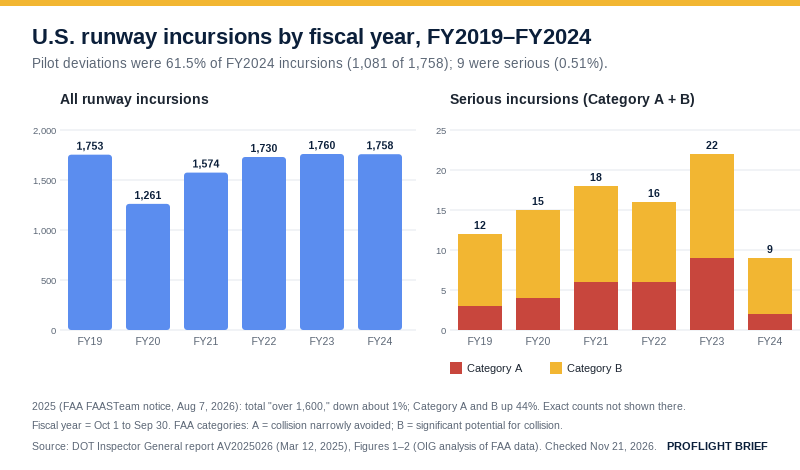
- FY2024: 1,758 incursions. Pilot deviations were 61.5% (1,081), operational incidents (controller actions) 17.9% (315), vehicle/pedestrian deviations 17.4% (306) and other 3.2% (56). Nine were Category A or B (0.51%), down 59% from 22 in FY2023 (DOT Inspector General report AV2025026 (Mar 12, 2025)).
- FY2019 to FY2024 totals: 1,753; 1,261; 1,574; 1,730; 1,760; 1,758 (same report, Figure 1).
- 2025: an FAA FAASTeam notice from the Honolulu runway safety forum says total incursions (“over 1,600”) fell about 1%, while “severe” Category A and B incursions rose 44% (FAASTeam notice NOTC5080 (Aug 7, 2026)). It doesn’t give exact counts, and the FAA’s own statistics dashboard (FAA Runway Safety Statistics) wouldn’t load for us, so we don’t print an FY2025 serious count.
Texas angle
The DOT IG listed every Category A and B incursion from the start of FY2022 through August 2024. Four were in Texas: Category A at Austin-Bergstrom on Feb 4, 2023 (controller-caused; the IG says two planes came within 100 feet of each other) and at Houston Hobby on Oct 24, 2023 (pilot deviation); Category B at Houston Intercontinental on Feb 28, 2022 (vehicle/pedestrian) and San Marcos Regional on Sep 8, 2022 (controller-caused) (DOT Inspector General report AV2025026 (Mar 12, 2025), Exhibit D). No DFW-area airport appears on that list. Flying in North Texas? See DFW pilot jobs and DFW flight schools.
Helicopter pilots: hover taxi and air taxi count too
The AIM treats helicopter taxi, hover taxi and air taxi as ground movements: helicopters “are expected to adhere to the same conditions, requirements, and practices as apply to other ground taxiing and ATC procedures,” and for air taxi “caution must be exercised concerning active runways and pilots must be certain that air taxi instructions are understood” (AIM 4-3-17 and 4-3-18, 4-3-17). Air taxi is normally not above 100 ft AGL; hover taxi is in ground effect below about 20 knots (Pilot/Controller Glossary (A); Pilot/Controller Glossary (H)). Controllers normally limit ground instructions to movement areas, so operations from nonmovement areas are at pilot discretion. InFO 26016 names Part 135 operators without carving out helicopters, so HEMS, tour and charter helicopter SOPs are in scope if the operator adopts it. See HEMS pilot jobs and this month’s helicopter ADs.
Sources
Checked Nov 21, 2026: FAA InFO 26016 (Nov 18, 2026); NTSB report AIR-24-01 (May 29, 2024); AC 120-74B, Flightcrew Procedures During Taxi Operations; AC 91-73B, Single Pilot and Flight School Taxi Procedures; 14 CFR 91.129(i) (eCFR, current); AIM 4-3-17 and 4-3-18; AIM 2-3 (markings and signs); FAA Order JO 7110.65, 3-7-2; Pilot/Controller Glossary (H); Pilot/Controller Glossary (A) (AIM, Pilot/Controller Glossary and JO 7110.65 effective Jul 9, 2026, Change 3); FAA Runway Status Lights page (last updated Aug 10, 2026); FAA: Runway Incursions (definitions and categories); DOT Inspector General report AV2025026 (Mar 12, 2025); FAASTeam notice NOTC5080 (Aug 7, 2026).
What we couldn’t verify
FY2025 exact counts (total and Category A/B): the FAA dashboard at FAA Runway Safety Statistics is an embedded viewer that blocked our access, and the FAASTeam notice gives only “over 1,600,” “about 1%” and “44%.” Trade press reports 13 serious incursions in FY2025; we haven’t seen that number on an FAA page, so it isn’t used. FY2019–2024 values are read from the DOT IG’s charts (Figures 1 and 2); the text confirms FY2024 (1,758 total, 9 serious) and FY2023 (22 serious). Which airlines or Part 135 operators will adopt the callout: Not published. Whether the RWSL list includes Dallas Love Field: it isn’t on the FAA’s list. We didn’t read the NTSB’s separate Austin report; the “within 100 feet” figure is the DOT IG’s.
Looking for employers? Browse the pilot employer & flight school directory.
FAQ
What is FAA InFO 26016?
An Information for Operators bulletin dated Nov 18, 2026. It recommends that Part 121, Part 135 and Part 91K operators change their SOPs so crews announce the runway they are about to cross, as shown on the runway sign, unless an aural advisory system is installed, and that operators with an SMS look for taxi errors caused by multitasking. It is voluntary guidance, not a regulation.
Is the runway-crossing callout required?
No. The InFO says conformity is voluntary. It becomes required for you only if your operator writes it into its SOPs. What is required is an explicit ATC clearance to cross any runway at a towered airport (14 CFR 91.129(i), AIM 4-3-18).
Why did the FAA issue the callout recommendation?
It answers NTSB Safety Recommendation A-24-2 from the Jan 13, 2023 JFK incursion, where American 106 (777) crossed runway 4L in front of Delta 1943 (737-900). Delta rejected its takeoff at about 105 knots and stopped 1,000 ft from the 777. The crew had checked the runway was clear but not which runway it was.
How many runway incursions happen each year?
1,758 in FY2024, per FAA data analyzed by the DOT Inspector General; 61.5% were pilot deviations and 9 were serious (Category A or B). An FAA FAASTeam notice says 2025 totals were over 1,600, down about 1%, with serious incursions up 44%.
What should I do if the tower clears me across but the runway lights are red?
Stop. The FAA says Runway Status Lights show runway status, not clearance, and pilots should hold short and tell ATC they are holding for red lights. DFW and IAH are among the 20 airports with the system.
Do helicopter hover taxi and air taxi need a runway crossing clearance?
Yes, on the movement area of a towered airport. The AIM treats taxi, hover taxi and air taxi as ground movements subject to the same ATC procedures, and warns pilots to be certain air taxi instructions are understood near active runways (AIM 4-3-17).
Related guides
- Airliner ADs this month
- Pilot in command authority (14 CFR 91.3)
- FAA ground stops explained
- ADS-B In mandate
- Pilot duty time & rest rules
- How to become a flight instructor (CFI)
- HEMS / air medical pilot jobs
- Helicopter ADs this month
- Pilot oxygen requirements
- Free 2026 Pilot Pay Guide (PDF)
Data checked Nov 2026. Pay and postings change, so verify with the employer. Estimates are labeled.