Issue #3 ·
ATC just tightened visual separation. Here's what changes in your cockpit.
ProFlight Brief: the week in professional aviation for airplane and helicopter pilots, in about seven minutes. Every fact links to its source.
Top storyThe FAA tightens visual separation
On Oct 28, two FAA air traffic notices took effect that change how controllers keep you apart from other traffic. The FAA laid them out in its October Air Traffic Procedures Bulletin. FAA Air Traffic Procedures Bulletin
What changed on Oct 28:
- Pilot-applied visual separation now has a floor. When you accept "maintain visual separation," controllers must not let your target merge with another aircraft's target with less than 500 ft vertical separation (Notice JO 7110.804). The FAA notes this applies to pilot-applied, not tower-applied, visual separation.
- Target resolution for VFR and IFR traffic. If two identified targets will come within 1.5 miles laterally, each aircraft must be on an assigned course or heading that keeps the targets from touching. Aircraft in a local VFR traffic pattern are excepted (Notice JO 7110.803). The notice also adds a new paragraph that lets controllers separate VFR from IFR aircraft by visual separation, 500 ft vertical, or target resolution. FAA Notice JO 7110.803
Coming in the Dec 24 update to the controllers' handbook (JO 7110.65):
- Helicopters and powered-lift: the interim rule becomes permanent. Controllers must not use visual separation for a helicopter or powered-lift aircraft crossing the path of arriving or departing traffic inside Class B, Class C or a TRSA.
- Altitude cap: visual separation generally drops to aircraft at or below 10,000 ft MSL, except on a visual approach, where it's still allowed up to (but not including) 18,000 ft.
Why it matters for you: Expect more vectors and assigned headings where you used to get "traffic in sight, maintain visual." Helicopter crews crossing a busy final in Class B or C should plan on being held or routed around arrivals rather than cleared across on visual. The FAA's bulletin is blunt about why: see-and-avoid "should not be exclusively relied upon" when aircraft are on an ATC clearance.
This week in aviationOct 26–Nov 1, 2026
- ⚡ Advanced air mobility: Joby and BETA flew Tampa Bay. On Oct 30, Joby's S4 and BETA's ALIA CX300 flew side by side from St. Petersburg's Albert Whitted (KSPG) to Tampa International (KTPA) in about 20 minutes, kicking off Florida's eVTOL Integration Pilot Program. Joby's S4 was set to land at a vertiport by Orlando International's Terminal C on Nov 2. Part 135 revenue flights could follow "probably late this year, early next year," per AIN's report. AIN
- 😴 Fatigue: a quarter of European pilots fly tired. A European Cockpit Association survey of almost 7,200 pilots found three in four have had microsleeps in the cockpit, and 24% say they usually keep flying rather than report themselves unfit from fatigue. The Guardian
- 🇨🇦 Duty time: Canada's northern airlines want longer days. A group of 18 small carriers asked Transport Canada for an exemption allowing 14-hour duty days instead of 13 and 70 hours a week instead of 60. ALPA's Capt. Tim Perry is opposing it. AvBrief
- ✈️ Single-pilot Citations: the door isn't closed. At NBAA-BACE, FAA Administrator Bryan Bedford said he's open to continued discussion of the agency's Sept 29 revocation of single-pilot exemptions for older Citations (I, II, S/II, Bravo, V, Ultra, Encore, Encore+). AIN
- 🚁 Rotor: two Airbus helicopter ADs take effect Nov 12. One requires inspecting the cargo-hook load-release system on AS350B2/B3, AS355N/NP and EC130B4 after a hook released a firefighting bucket without the pilot commanding it. Federal Register The other adds repetitive checks of the tail-rotor gearbox input flange on the SA365N to head off a possible loss of yaw control. Federal Register
- 🔌 Rotor: proposed AD limits some AS350B3 and EC130B4 starter-generators to 180 amps. It would require an RFM supplement change and a "MAXIMUM CONTINUOUS GENERATOR LOAD = 180A" placard for P/N 200SGL130Q and 200SGL130Q-4 within 100 hours. Comments are due Dec 14. Federal Register
Tech in the cockpitText your IFR clearance, see closures on the diagram
- FAA Mobile Clearance comes to GA in early 2027. GA pilots will be able to request and receive an IFR departure clearance by text through ForeFlight and Garmin apps instead of calling on the radio. The evaluation started in May at Sugar Land (SGR), Galveston (GLS) and Hooks (DWH), then expanded to Appleton (ATW) and New Century (IXD). IFR cancellation on landing at select non-towered fields is planned too. Aviation Week
- Garmin Pilot Web gets SmartCharts airport diagrams with graphical NOTAMs. Color-coded overlays show runway, taxiway and ramp closures. Garmin Pilot also added composite radar for Mexico, more of Canada, and a forecast cloud layer. AIN
- ForeFlight in the sim. Project Magenta's instructor station now sends simulator position to ForeFlight, so you can run your real EFB in the sim. Project Magenta
Pilot's take: A texted clearance still has to be read, loaded and cross-checked. Treat it like a PDC: compare it to what's in the box before you taxi, and call if anything doesn't match.
Pay & hiringMajor-airline hiring through September, and Texas helicopter pay
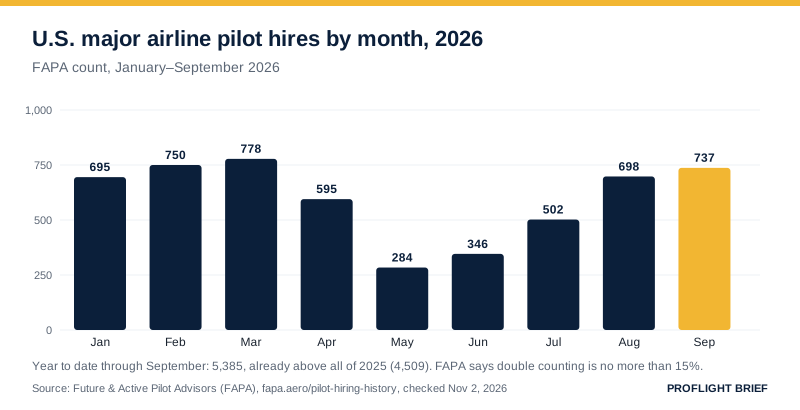
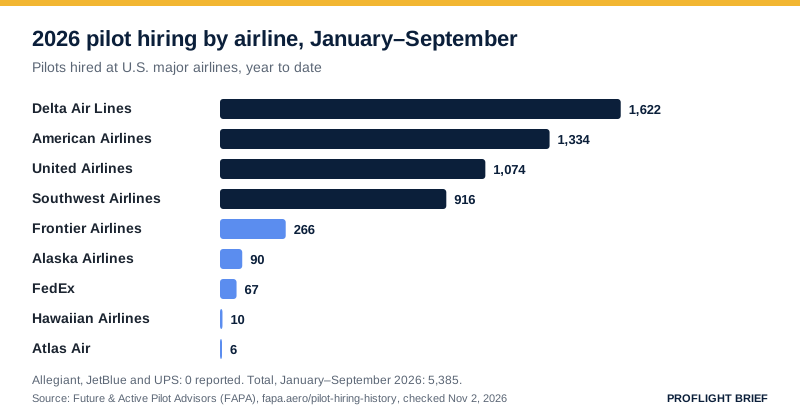
September hiring came in at 737. FAPA's latest count shows U.S. major airlines hired 737 pilots in September, led by United (279), American (185) and Delta (178). That puts 2026 at 5,385 through September, already ahead of all of 2025 (4,509). FAPA also revised earlier months: January–August now totals 4,648, up from the 4,511 we reported last issue. FAPA says its method can double-count by up to 15%. FAPA
The longer view: ALPA's October analysis counts 105,244 pilots employed by U.S. carriers in 2025, the most ever recorded, and says hiring over the 12 months ending July 2026 was up 74% from a year earlier. ALPA
Texas helicopter pay, by town. We pulled every open full-time air medical pilot posting in Texas on Oct 31. Posted base pay runs from $82,900–$93,251 (Air Methods, El Paso) to $125,260–$137,789 (Med-Trans in seven West Texas and Panhandle towns). The Denton float position near DFW posts $102,072–$112,280. GMR careers · Air Methods posting 10684 · Full Texas helicopter jobs guide

Safety lessonAn R44, three passengers, and a CG nobody calculated
The case: On Sept 13, 2026, a private pilot in Natchez, Mississippi, was already airborne in his R44 II when he called three people and invited them on a sightseeing flight. He estimated their weights, believed he'd be under the 2,500 lb max gross weight, put the heaviest passenger up front and the other two in back. As he lifted off, the helicopter pitched nose down and accelerated forward. He couldn't arrest the forward motion or the descent; a main rotor blade and the right skid hit the ground. All four people walked away, but the helicopter was substantially damaged. After the accident the pilot ran the numbers and found the CG was beyond the forward limit. The NTSB's probable cause: the pilot's failure to complete a preflight weight and balance calculation. The pilot had about 1,848 hours total and 146 in type. NTSB final report CEN26LA317
Brief this, whether you fly airplanes or helicopters:
- Gross weight isn't the whole check. You can be under max gross and still outside the CG envelope. In a light helicopter, one heavy front-seat passenger can use up all your forward cyclic margin.
- A changed load is a new flight. Adding passengers mid-day means a fresh W&B, not the one from this morning, and certainly not a guess.
- Ask for weights, don't eyeball them. People routinely underestimate. Use real numbers and include fuel burn to the landing CG.
- Lift to a hover and assess. If the cyclic position or attitude looks wrong at the hover, set it down. Don't try to fly out of it.
Quick hitsWorth knowing
- Porter picket Nov 18: Porter's more than 900 pilots plan an informational picket at Billy Bishop on Nov 18; conciliation runs to Nov 22 and Dec 13 is the earliest legal strike or lockout date. ALPA
- AStar servo AD comments due Dec 3: last issue's proposed main-rotor servo torque inspection for AS350B3, AS355 and EC130 is still open for comment. Federal Register
- Oxygen rule comments due Nov 23: the FAA's proposed changes to pilot oxygen requirements are still open. FAA rulemaking
- Flying in Central Texas? Our new Austin, San Antonio and Houston pages list the employers and flight schools there, each with sources and the date we checked.
That's the brief. Fly safe, and get home to the people waiting for you.
Nicholas
Spotted an error? Reply and we'll correct it in the next issue. ProFlight Brief is informational, not flight instruction or medical advice. Follow your AFM/RFM, your operator's procedures, and your AME.