Guides · Updated
FAA Medical for Anxiety, Depression and Antidepressants: What Changed on Nov 18, 2026 (No HIMS AME, Fast Track, Medication Changes)
If you are in crisis or thinking about suicide, call or text 988 (Suicide & Crisis Lifeline, U.S.). This page is not medical or legal advice. Talk to your AME and your treating provider about your own case, and never start, stop or change a medication to fit FAA rules without your prescriber.
Updated Nov 23, 2026. The FAA posted a new revision of the AME Guide on Wednesday, Nov 18, 2026. Its AME Alert lists new disposition tables for anxiety and depression on and off treatment, a Fast Track pathway, a table for antidepressants taken for non-mental-health conditions, and new tools, including a Mental Health History Checklist and a “Who Do I Need to See?” guide (FAA Guide for Aviation Medical Examiners, home page and AME Alert (revision Nov 18, 2026)). Every point below comes from those FAA documents. For the bigger picture (therapy rules, the 2024 FAA committee and the Mental Health in Aviation Act in Congress), see our pilot mental health & FAA medical guide.
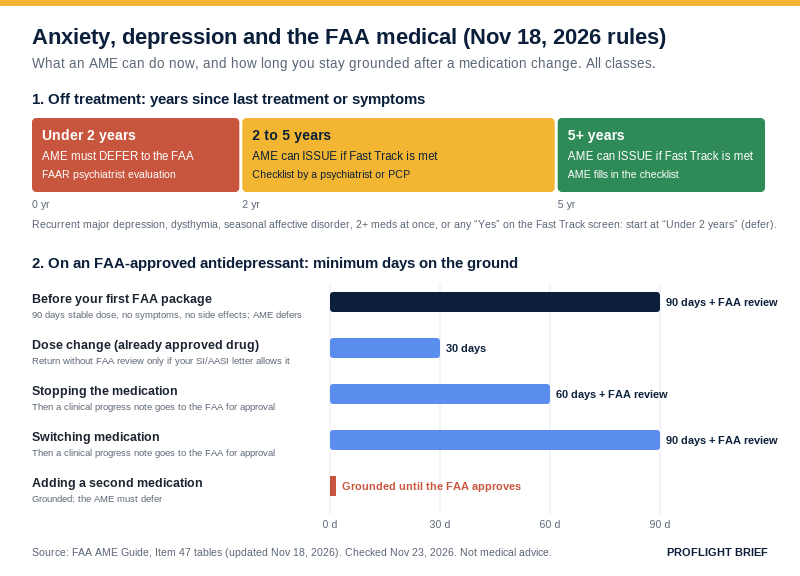
What changed, in the FAA’s own words
The FAA’s change log for version 11/18/2026 lists 14 numbered changes to Item 47 (AME Guide Archives and Updates, version 11/18/2026 (changes 1–14)). The ones that matter most to pilots:
- No HIMS AME requirement for antidepressants. Change 7 adds the new ON Treatment table and “Removed requirements for HIMS AME. Will need board certified psychiatrist evaluation and completion of Mental Health History Checklist.”
- The old SSRI pathways are gone. Change 1: “Removed Pathway I and II. Created disposition tables for ON Treatment and OFF Treatment.” Psychosis, bipolar and personality disorder text moved into disposition tables.
- Some dose changes without FAA review. Change 13 adds a medication-changes page that “Allows some pilots to return to duty after medication dose change without FAA review.”
- New names for the evaluators. HIMS psychiatrists, psychologists and neuropsychologists are now FAA Recognized (FAAR) psychiatrists, psychologists and neuropsychologists. The FAA notes “The term HIMS AME has not changed” (FAA Guide for Aviation Medical Examiners, home page and AME Alert (revision Nov 18, 2026)).
The FAA’s evaluator guide now describes HIMS AMEs as AMEs with advanced training “to evaluate and monitor pilots and Air Traffic Control Specialists (ATCS) with a history of substance use disorders” (Who Do I Need to See? Navigating FAA Mental Health Evaluators (11/18/2026)). NBAA says the change expands the pool of AMEs who can see pilots on antidepressants “nearly tenfold” (NBAA (Nov 20, 2026)); that figure is NBAA’s, not the FAA’s.
Off treatment: when an AME can issue in the office
This is the biggest practical change for the many pilots with a past diagnosis. The OFF Treatment table covers any combination of conditions on the FAA’s list (Anxiety, Depression, and Related Conditions (OFF Treatment) disposition table (11/18/2026); Anxiety, Depression, and Related Conditions List (11/18/2026)):
| Time since last treatment or symptoms (whichever is more recent) | What the AME reviews | AME action |
|---|---|---|
| 5 or more years, no symptoms, never on 2+ mental health medications at once | Available medical records; the AME completes the Mental Health History Checklist and the Fast Track page. No treating-provider evaluation required. | ISSUE if Fast Track criteria are met |
| 2 to 5 years, no symptoms | Your typed, signed personal statement; complete mental health records from all providers; a comprehensive clinical psychiatric evaluation by a community clinician (psychiatrist or PCP) or a FAAR psychiatrist; the checklist signed by that evaluator | ISSUE if all Fast Track requirements are met; the FAA may still ask for more |
| Under 2 years, or any “Yes” on the Fast Track screen, recurrent episodes, failed attempts to stop medication, recurrent major depression, current uncontrolled symptoms, seasonal affective disorder or persistent depressive disorder (dysthymia) | Personal statement; complete records; a comprehensive independent psychiatric evaluation by a FAAR psychiatrist; checklist signed by the FAAR psychiatrist. If checklist question 1 (cognitive deficits) is “Yes,” a FAAR neuropsychology evaluation is also required. | DEFER to the FAA for a possible Special Issuance |
The Fast Track screen is four yes/no questions the AME answers after reviewing the checklist and records: any mental health medication in the past 2 years; any “Yes” on the checklist; any missing records; any aeromedical concerns. All four “No” means the AME may issue (if you’re otherwise qualified) and must counsel you to self-ground under 14 CFR 61.53 if your condition changes or treatment resumes. Any “Yes” means defer (OFF Treatment Fast Track Pathway for the AME (11/18/2026)).
Which conditions count. The FAA list covers unspecified anxiety, generalized anxiety disorder, situational anxiety, social anxiety disorder, unspecified depression, a single resolved episode of major depressive disorder, postpartum depression, situational depression, OCD, PTSD and DSM V-code/ICD-10 Z-code items such as uncomplicated bereavement, relationship distress and “phase of life” problems. Recurrent major depression, dysthymia and SAD start on the defer row (Anxiety, Depression, and Related Conditions List (11/18/2026)).
Situational depression has its own table: a single episode that fully resolved within 6 months of onset, with at least 2 months off all psychiatric medication, can be issued by the AME using a decision tool, whether it was more than 5 years ago or within the past 5 years (the second case needs a current detailed clinical progress note covering six listed items). Anything else, including current “as needed” medication, is deferred (Situational Depression disposition table (11/18/2026)).
On one approved antidepressant: the new package
You can still fly on an antidepressant only through an FAA Special Issuance, and the AME still can’t issue the first one. The ON Treatment table says: “After 90 days on a stable medication dose and symptom-free, obtain and submit for FAA review” (Anxiety, Depression, and Related Conditions (ON Treatment) disposition table (11/18/2026)):
- A typed, signed, dated personal statement.
- A FAAR neuropsychologist evaluation: complete report and cognitive testing battery.
- Complete mental health records from all past and current providers.
- A clinical evaluation and the Mental Health History Checklist. If your prescriber is a board-certified psychiatrist: a progress note under 90 days old from that psychiatrist, plus the checklist signed by them. If your prescriber is not (PCP, NP, PA): their recent progress note, plus a comprehensive assessment from an independent board-certified psychiatrist who signs the checklist.
The FAA’s pilot sheet adds: don’t fly under 61.53 until you have the FAA’s authorization; the 90 days must be on a stable dose with no symptoms and no side effects; bring every document to the exam; the AME “is required to submit your exam as DEFERRED”; the complete package should be uploaded within 14 days of the exam; and “partial or incomplete packages will NOT be reviewed” (Pilot Information: Certification Steps (On Treatment) (11/18/2026)). There is a do-not-submit checklist to make sure your package is complete (Antidepressant Initial Document Checklist (11/18/2026)).
The drug list didn’t change. The 9 conditionally acceptable antidepressants (single agent, with SI) are citalopram, escitalopram, fluoxetine, sertraline, desvenlafaxine, duloxetine, venlafaxine, bupropion SR/ER and vilazodone. Fluvoxamine, paroxetine, levomilnacipran, bupropion IR, vortioxetine, esketamine, all tricyclics and all MAOIs remain unacceptable (FAA Antidepressant Medications list (11/18/2026)).
Renewals (AASI). If your authorization letter puts you in the AME Assisted Special Issuance program, your AME can reissue at later exams if you bring: the authorization; detailed clinical progress notes at least every 6 months, at least one of them from an MD/DO, with the most recent no more than 90 days before the exam; and the new Status Summary completed by your treating physician and AME. New symptoms, a new diagnosis, progression, or any provider or AME concern means a deferral (AASI for Anxiety, Depression, and Related Conditions (11/18/2026)).
Changing your medication once you have an authorization
| Change | Minimum self-grounding | Who decides you can return |
|---|---|---|
| Dose change (same approved drug) | 30 days, and clinically stable | If your SI/AASI letter permits it: you, with your treating provider; no reports to the FAA first. If not: complete the 30 days and send a detailed clinical progress note to the AME or FAA. |
| Switch to another medication (including within the same class) | 90 days, and clinically stable | The FAA, after a detailed clinical progress note explaining the switch |
| Add a medication | Grounded (AME must defer) | The FAA |
| Stop the medication (with your provider, “never on their own”) | 60 days, and clinically stable | The FAA, after a detailed clinical progress note on the discontinuation |
Source: Antidepressant Medication Changes With a Current FAA Authorization (11/18/2026). FAA air traffic controllers follow different rules (all changes go through the Regional Flight Surgeon). NBAA describes the 60-day figure as a cut from 90 days (NBAA (Nov 20, 2026)); we couldn’t confirm the previous number in an FAA document.
Antidepressants for something else
If you take an acceptable antidepressant for a clearly documented non-mental-health condition (the FAA’s examples: peripheral neuropathy, IBS, menopausal vasomotor symptoms, smoking cessation), the new table asks for at least 4 weeks on the drug with symptoms resolved and no side effects, a progress note no more than 90 days old that names the condition and the reason for the drug and confirms no side effects, the Mental Health History Checklist from your treating physician, and records showing the condition has no mental health relationship. The medication still requires a Special Issuance (Antidepressant Medication for Non-Mental Health Conditions (11/18/2026)).
The new Mental Health History Checklist
Your provider (or, at 5+ years off treatment, your AME) completes it after an in-person evaluation and record review, and attaches a signed clinical note. It asks when your most recent symptoms, diagnosis or treatment were (never, under 2 years, 2–5 years, 5+ years) and 11 yes/no questions: cognitive deficits; active or unstable symptoms or poor insight; any history of bipolar disorder, psychosis, personality, eating, somatic or dissociative disorder; an IEP/504 plan for mental health or ADHD medication in the last 4 years; current mental health medications (and any dose change in 3 months); ever 2+ psychiatric drugs at once; mood stabilizers, antipsychotics, TMS, ECT, ketamine or esketamine; suicide attempt, self-harm, IOP/PHP or inpatient care; substance-use red flags (including two DUI arrests or a 0.15 BAC); criminal history, gambling or behavioral addiction; and violence, repeated falsification or disregard for safety rules (Mental Health History Checklist (11/18/2026)).
Who you may need to see
- Your AME does the exam and issues or defers. For antidepressants, the FAA no longer requires a HIMS AME (AME Guide Archives and Updates, version 11/18/2026 (changes 1–14)).
- A board-certified psychiatrist (ABPN or AOBNP): evaluation and checklist for pilots on medication.
- A FAAR psychiatrist does the Comprehensive Independent Psychiatric Evaluation (for example, the under-2-years row). The FAA says the FAAR psychiatrist “MUST NOT be the treating physician.”
- A FAAR neuropsychologist does cognitive testing (needed for the on-treatment package). A FAAR psychologist is limited to certain assessments, including antidepressant cases, and must refer to a neuropsychologist if cognitive screening isn’t favorable.
- A HIMS AME is for pilots with a history of substance use disorders (Who Do I Need to See? Navigating FAA Mental Health Evaluators (11/18/2026)).
Other conditions at a glance
From the FAA’s new AME quick decision guide (AME Mental Health Quick Decision Guide (11/18/2026)): ADHD on the Fast Track (at least 4 years clear) can be issued; ADHD on the standard track, on medication or less than 90 days off it is deferred; any suicide attempt, and any history of bipolar disorder, psychosis or personality disorder, is deferred.
What did not change
- The regulations. The medical standards are still 14 CFR 67.107, 67.207 and 67.307, cited at the top of Item 47 (AME Guide, Item 47 Psychiatric Conditions: Aerospace Medical Dispositions (updated Nov 18, 2026)). The only Part 67 change in the Federal Register this month is a Nov 23 technical amendment renaming the “Aerospace Medical Certification Division” in 67.401, 67.407 and 67.409 (FAA technical amendment, FR Doc. 2026-23786 (Nov 23, 2026)).
- Therapy. The FAA’s therapy FAQ (May 27, 2026) is still the current version: therapy is compatible with an unrestricted medical, and visits to licensed providers go on your next MedXPress (see our mental health guide).
- Self-grounding. 61.53 still applies; the new pages repeat it.
- Congress. The Mental Health in Aviation Act (S. 3257) was still listed as held at the House desk since Oct 1, 2026 when we checked on Nov 23.
What this means for working pilots
For airline, corporate, HEMS and helicopter pilots who had counseling or a short course of medication years ago, the change is in the AME’s office: if you’re more than 2 years out, have no symptoms, took no mental health medication in the past 2 years and the checklist is clean, the AME may be able to issue at the exam instead of deferring to the FAA. Start by getting your records together and calling your AME before the exam. For pilots on medication, the wait is still 90 days plus FAA review, but you no longer need to find one of the scarcer HIMS AMEs, and a routine dose change no longer has to mean an FAA review if your letter allows it. Your company’s and union’s policies may add their own steps; check them.
Sources
Checked Nov 23, 2026: FAA Guide for Aviation Medical Examiners, home page and AME Alert (revision Nov 18, 2026); AME Guide Archives and Updates, version 11/18/2026 (changes 1–14); AME Guide, Item 47 Psychiatric Conditions: Aerospace Medical Dispositions (updated Nov 18, 2026); Anxiety, Depression, and Related Conditions (OFF Treatment) disposition table (11/18/2026); OFF Treatment Fast Track Pathway for the AME (11/18/2026); Anxiety, Depression, and Related Conditions List (11/18/2026); Situational Depression disposition table (11/18/2026); Anxiety, Depression, and Related Conditions (ON Treatment) disposition table (11/18/2026); Pilot Information: Certification Steps (On Treatment) (11/18/2026); Antidepressant Initial Document Checklist (11/18/2026); FAA Antidepressant Medications list (11/18/2026); AASI for Anxiety, Depression, and Related Conditions (11/18/2026); Antidepressant Medication Changes With a Current FAA Authorization (11/18/2026); Antidepressant Medication for Non-Mental Health Conditions (11/18/2026); Mental Health History Checklist (11/18/2026); Who Do I Need to See? Navigating FAA Mental Health Evaluators (11/18/2026); AME Mental Health Quick Decision Guide (11/18/2026); FAA technical amendment, FR Doc. 2026-23786 (Nov 23, 2026); NBAA (Nov 20, 2026).
What we couldn’t verify
How long FAA review takes under the new tables: not published. The previous waiting period after stopping a medication (NBAA says 90 days; we didn’t find it in an FAA document). How many AMEs can now handle antidepressant cases (NBAA’s “nearly tenfold” is its estimate). The FAA’s older AME Guide page “Use of Antidepressant Medications” (last updated Dec 3, 2025) is still online and still mentions HIMS AMEs and SSRI Decision Paths; the Nov 18 change log says those paths and the HIMS AME requirement were removed, so we follow the Nov 18 documents. We didn’t find an FAA press release about the change. Congress.gov timed out for us on Nov 23; the S. 3257 status comes from its listing as of that day.
Looking for employers? Browse the pilot employer & flight school directory.
FAQ
Do I still need a HIMS AME if I take an antidepressant?
No. The FAA’s Nov 18, 2026 change log says it “Removed requirements for HIMS AME” for the new on-treatment table. You need a board-certified psychiatrist’s evaluation (or an independent one if a PCP, NP or PA prescribes), a FAAR neuropsychologist evaluation, complete records and the Mental Health History Checklist. Your regular AME defers the package to the FAA.
Can my AME issue a medical if I was treated for depression or anxiety years ago?
Often, yes, as of Nov 18, 2026. If you’re 5+ years past treatment or symptoms, or 2 to 5 years with a checklist from a psychiatrist or PCP, and you pass the FAA’s 4-question Fast Track screen (no mental health medication in 2 years, no “Yes” on the checklist, no missing records, no AME concerns), the AME may issue. Recurrent major depression, dysthymia and seasonal affective disorder are deferred.
How long do I have to wait on an antidepressant before the FAA will look at it?
90 days on a stable dose with no symptoms and no side effects. Then your AME defers your complete package to the FAA for a Special Issuance; FAA review time isn’t published. You can’t fly until you receive the authorization.
Can I change my antidepressant dose and keep flying?
With an existing authorization: you self-ground at least 30 days and must be clinically stable. If your SI/AASI letter explicitly permits dose changes, you can return without sending anything to the FAA first; otherwise, send a detailed clinical progress note after the 30 days. Switching drugs means 90 days and FAA approval; adding a drug grounds you until the FAA approves.
How long after stopping an antidepressant can I fly?
If you hold an authorization, the FAA’s Nov 18 table says at least 60 days self-grounded after stopping, clinically stable, then a detailed clinical progress note goes to the FAA for approval. Stop only with your prescriber; the FAA says never on your own.
Which antidepressants does the FAA accept?
Unchanged on Nov 18, 2026: citalopram, escitalopram, fluoxetine, sertraline, desvenlafaxine, duloxetine, venlafaxine, bupropion SR/ER and vilazodone, used alone, with a Special Issuance. Paroxetine, fluvoxamine, levomilnacipran, bupropion IR, vortioxetine, esketamine, tricyclics and MAOIs are not accepted.
Did the FAA change the regulations?
No. The Nov 18 revision is to the Guide for Aviation Medical Examiners, the FAA’s instructions to AMEs. The medical standards in 14 CFR 67.107, 67.207 and 67.307 didn’t change.
Related guides
- Pilot mental health & the FAA medical
- Pilot in command authority (14 CFR 91.3)
- Pilot duty time & rest rules
- HEMS / air medical pilot jobs
- How to become a flight instructor (CFI)
- Airline cadet programs compared
- Pilot oxygen requirements
- FAA pilot jobs (Flight Test & ASI)
- Airline pilot hiring 2026
- Free 2026 Pilot Pay Guide (PDF)
Data checked Nov 2026. Pay and postings change, so verify with the employer. Estimates are labeled.