Guides · Updated
Military Pilot to Airline (2026): FAA Certificates, 750-Hour R-ATP, Airline Military Programs and GI Bill Flight Training
Veterans Day is Wednesday, Nov 11, and the airlines are courting military aviators again: Southwest launched its Military Aviator Program this year, United runs a Military Pilot Program that hands out conditional job offers before separation, and American’s regionals advertise military transition help. This guide sticks to what the FAA, the VA and the airlines publish. Helicopter pilots should also read our helicopter to airline guide, which covers rotor transition programs and the airplane-specific hours in detail.
Step 1: Turn military ratings into FAA certificates (14 CFR 61.73)
A U.S. military pilot or former military pilot can apply for an FAA commercial pilot certificate, an instrument rating and a type rating on the basis of military qualifications. The exception is anyone “removed from flying status for lack of proficiency or because of a disciplinary action involving aircraft operations” (14 CFR 61.73 (eCFR)). You need:
- Records showing you are or were a military pilot, graduated from U.S. Armed Forces undergraduate pilot training with a military pilot rating, and passed a pilot proficiency check and instrument proficiency check as a military pilot (§61.73(h)).
- The Military Competency (MCN) knowledge test on commercial privileges and limitations, air traffic and general operating rules, and accident reporting (§61.73(b)(2)). The FAA’s MCN standards say the test has 50 questions, you get up to two hours, and you need 70% or better to pass. The test report expires 24 calendar months after the month you take it (FAA Commercial Pilot – Military Competence ACS (PDF)).
- Recent military proof for each rating: either an official military pilot and instrument proficiency check in that category, class and type, or 10 hours of pilot time as a military pilot in that category, class and type (§61.73(b)(3)).
- Instrument rating: a military instrument proficiency check in that category, plus a record showing you are qualified to fly instruments on Federal airways (§61.73(d)).
- Type ratings are only issued for military types that have a comparable civilian type designation (§61.73(e)).
- Flight instructor: military instructor pilots and pilot examiners can get a CFI with military records plus a knowledge test on the §61.185(a) knowledge areas passed within the preceding 24 calendar months, if they already hold a commercial or ATP certificate with an instrument rating (§61.73(g)).
Step 2: The 750-hour military R-ATP (14 CFR 61.160(a))
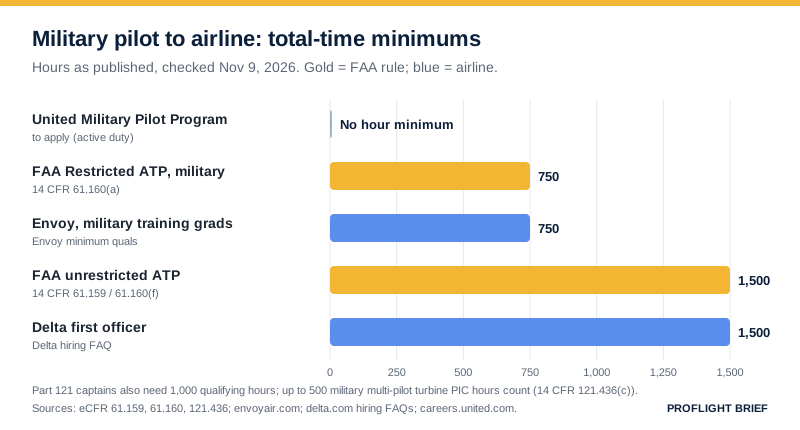
Every airline first officer needs an ATP. A U.S. military or former U.S. military pilot can apply for a Restricted ATP (airplane multi-engine) with 750 hours total time as a pilot, compared with 1,500 for the unrestricted certificate (14 CFR 61.160 (eCFR)). You must present a DD-214 showing an honorable discharge, or an official record showing you are currently serving, plus a record showing you graduated military undergraduate pilot training. The same disqualification for proficiency or disciplinary removal applies. You still have to meet the other §61.159 experience items, except cross-country can be 200 hours (§61.160(e)).
Two practical notes from the rules. First, before the ATP knowledge test, everyone needs the ATP Certification Training Program (CTP): at least 30 hours of classroom work and 10 hours in a simulator, including 6 in a Level C or higher full flight simulator of a multi-engine turbine airplane of 40,000 lb or more (14 CFR 61.156 (eCFR)). Second, a Restricted ATP holder can’t act as a Part 121 pilot in command until meeting the full §61.159 experience and age requirements (14 CFR 61.167 (eCFR)). See our hours-to-ATP tracker to check your logbook against every line item.
Step 3: Military credit toward a captain seat (14 CFR 121.436)
A Part 121 captain needs an unrestricted ATP, a type rating and 1,000 hours of qualifying time (Part 121 SIC, or certain Part 135 and 91K PIC time). Military pilots can credit 500 hours of military flight time toward that 1,000 if it was PIC in a multi-engine, turbine-powered, fixed-wing airplane or powered-lift, in an operation requiring more than one pilot (14 CFR 121.436 (eCFR)). That credit matters for upgrade timing and for Direct Entry Captain applications.
Airline military programs compared (checked Nov 9, 2026)
| Airline | Program / who | Published hour or certificate rules | What it offers |
|---|---|---|---|
| United (United Military Pilot Program) | United Military Pilot Program: active duty (including TAR, FTS and AGR active reserves) flying manned aircraft, more than 12 months from availability and separation | “No flight-hour minimums or ATP certificate are required to apply.” You must meet United’s transition requirements before starting (details: Not published on the program page) | Conditional job offer (CJO) for accepted candidates; a Buddy program pairing you with a United pilot; participant-only updates and events. Pilots already separated or flying in the part-time reserve component get a separate application link on the program page |
| Southwest (Southwest Military Aviator Program) | Military Aviator Program (MAP): current U.S. military pilots more than 6 months from projected date of availability | Must meet the Southwest flight experience requirements in the posting; current military medical recommendation. Unrestricted ATP, FCC permit and FAA first-class medical not needed to interview, but required before final MAP validation (typically 3 months before availability). Southwest’s FO page prefers 500 h fixed-wing turbine and counts only fixed-wing time, not simulator, helicopter, WSO, RIO, FE, NAV, EWO or UAV time (Southwest pilot careers) | Interview before separation; ongoing communication and mentorship from veteran Southwest pilots. Selection does not guarantee employment. Current application window: Not published on the MAP page (it asks pilots to join the MAP Talent Community) |
| Delta (Delta pilot hiring FAQs) | No separate program; military pilots apply up to 24 months before retirement or 12 months before separation | Minimum 1,500 h total; 1,000 h fixed-wing turbine preferred (at least 500 turbine hours in a non-powered-lift airplane); 250 h PIC/SIC per §61.159(a)(5) in airplanes; 50 h multi-engine; commercial with instrument airplane; first-class medical; ATP written; must meet “applicable flight hour and certification conversions” | Veteran employee resource groups |
| Envoy (Envoy military pilots page) | Fixed-wing and rotor veterans; helicopter pilots tick “Rotor Transition Program” on the airlineapps.com application | 750 h total for military flight training graduates, plus 250 h fixed-wing PIC, 200 h cross-country, 100 h night, 75 h instrument, 50 h multi-engine fixed-wing (may be reduced to 25) and the ATP written (Envoy pilot minimum qualifications) | Help using education benefits and military experience to earn civilian ratings; interview at Irving, Texas HQ with travel and lodging provided as needed; 9–10 week paid training at the Irving Flight Academy with hotel and per diem |
| Piedmont (Piedmont military pilots transition program) | Military pilots, including Black Hawk, Apache and Seahawk pilots | Not published (a recruiter builds a no-obligation plan) | Matches pilots with flight schools for missing fixed-wing hours or a multi-engine rating; training in Trenton, NJ, then a path to American |
For rotor-specific programs with funding (CommuteAir, GoJet, SkyWest, Frontier, JetBlue Gateway), see helicopter to airline. For each carrier’s pay, see airline pilot pay and regional FO pay.
Paying for missing ratings: GI Bill flight training
The VA says you can use the Post-9/11 GI Bill or the Montgomery GI Bill (Active Duty or Selected Reserve) for flight training if all of these are true: you already hold a private pilot certificate; on the day you enroll you hold a second-class medical (first-class if you’re pursuing the ATP); the school is an FAA Part 141 pilot school or Part 142 training center; and the program is VA-approved (VA: GI Bill flight training; 38 CFR 21.4263 (eCFR)).
| Benefit | What VA pays for flight training (Aug 1, 2026–Jul 31, 2027) |
|---|---|
| Post-9/11 GI Bill (Ch. 33), non-degree flight training | Net tuition and fees up to $17,661.89 a year at the 100% tier, paid to the school. No monthly housing allowance and no books stipend for flight training (VA: Post-9/11 GI Bill rates 2026–27) |
| Post-9/11 GI Bill, flight training inside a degree at a private college | Net tuition and fees up to $30,908.34 a year; public schools: net in-state tuition and fees (VA: Post-9/11 GI Bill rates 2026–27) |
| Montgomery GI Bill (Active Duty or Selected Reserve) | Reimburses 60% of approved flight school fees (VA: GI Bill flight training) |
If you served less than 36 months on active duty, the Post-9/11 amounts are prorated (for example, 18–23 months is 70% and 30–35 months is 90%) (VA: Post-9/11 GI Bill rates 2026–27). Ask the school’s VA certifying official which courses at your campus are approved before you sign anything. In the directory, US Aviation Academy (Denton) lists itself as Part 141 and GI Bill approved: see the listing. Compare more North Texas schools on our DFW flight schools page.
The Texas angle
Several of these programs run through Dallas–Fort Worth. Southwest is headquartered at Dallas Love Field and trains new first officers for about two months at its LEAD Center in Dallas (Southwest pilot careers). Envoy interviews and trains at its Irving headquarters next to DFW (Envoy military pilots page). See DFW pilot jobs for bases and published pay, and FAA pilot jobs and CBP Air and Marine Operations if you want to stay in federal service.
What we couldn’t verify
- United’s “transition requirements” and program guide details (not on the program page we checked).
- Southwest MAP application dates: a recruiter’s LinkedIn post said an application window closed Oct 8, and a job-board copy lists a Jan 31, 2027 deadline. Neither is on Southwest’s own MAP page, so we don’t rely on either.
- American Airlines mainline military hiring rules: jobs.aa.com/military was showing a site-upgrade notice with no pilot requirements when checked.
- Southwest’s first-officer starting rate appears only on job-board copies of the MAP posting, so we left it out.
- Whether a given military aircraft has a comparable civilian type designation (§61.73(e)). Ask your FSDO or examiner.
Sources (all checked Nov 9, 2026): 14 CFR 61.73 (eCFR); FAA Commercial Pilot – Military Competence ACS (PDF); 14 CFR 61.160 (eCFR); 14 CFR 61.156 (eCFR); 14 CFR 61.167 (eCFR); 14 CFR 121.436 (eCFR); United Military Pilot Program; Southwest Military Aviator Program; Southwest pilot careers; Delta pilot hiring FAQs; Envoy military pilots page; Envoy pilot minimum qualifications; Piedmont military pilots transition program; VA: GI Bill flight training; VA: Post-9/11 GI Bill rates 2026–27 (page updated Oct 13, 2026); 38 CFR 21.4263 (eCFR).
Looking for employers? Browse the pilot employer & flight school directory.
FAQ
Can a military pilot get an FAA commercial certificate without a checkride?
Yes, under 14 CFR 61.73. A U.S. military or former military pilot with the required military records passes the 50-question Military Competency (MCN) knowledge test (70% to pass) and applies for a commercial certificate, instrument rating and comparable type ratings based on military qualifications. Pilots removed from flying status for proficiency or aircraft-related discipline aren't eligible.
How many hours does a military pilot need for an ATP?
750 hours total time for a Restricted ATP under 14 CFR 61.160(a), with a DD-214 showing honorable discharge (or proof of current service) and proof of graduating military pilot training. The unrestricted ATP needs 1,500. Everyone must complete the ATP CTP before the knowledge test.
Does military flight time count toward the 1,000 hours to be an airline captain?
Up to 500 hours. 14 CFR 121.436(c) allows 500 hours of military PIC time in multi-engine turbine fixed-wing airplanes or powered-lift, in operations requiring more than one pilot, toward the 1,000 qualifying hours a Part 121 captain needs.
Does United require an ATP for its Military Pilot Program?
Not to apply. United says no flight-hour minimums or ATP certificate are required to apply; candidates must be active duty (including TAR, FTS and AGR active reserves), more than 12 months from availability and separation, and must meet United's transition requirements before starting.
When should a military pilot apply to Delta or Southwest?
Delta encourages military pilots to apply up to 24 months before retirement or 12 months before separation. Southwest's Military Aviator Program is for current military pilots more than 6 months from their projected date of availability; the ATP, FCC permit and first-class medical are due before final validation, typically 3 months before availability.
How much does the GI Bill pay for flight training in 2026?
For Aug 1, 2026 to Jul 31, 2027, the Post-9/11 GI Bill pays net tuition and fees up to $17,661.89 a year for non-degree flight training at the 100% tier, with no housing allowance. The Montgomery GI Bill reimburses 60% of approved fees. You need a private pilot certificate and a second-class medical first, and the school must be Part 141 or 142 and VA-approved.
Related guides
- Helicopter to airline
- Hours to ATP
- Direct Entry Captain jobs
- Airline pilot hiring 2026
- Airline pilot pay
- Regional FO pay
- FAA pilot jobs (Flight Test & ASI)
- Pilot pay calculator
- Free 2026 Pilot Pay Guide (PDF)
Data checked Oct 2026. Pay and postings change, so verify with the employer. Estimates are labeled.